New Report: Home-Improvement Market Keeps Growing

(Source: millionacres.com) 

Jun 22, 2021 by Liz Brumer


If you haven't walked into a home-improvement store lately, you may be surprised to learn that the inventory of building materials is shockingly low. Windows are back-ordered six months or more, lumber prices are through the roof, and good luck finding the appliance you want. This home-goods shortage was spurred by COVID-19 after factories shut down and a huge increase in consumer demand. To better understand the current home-improvement market dynamics, Angi (NASDAQ: ANGI) recently released an in-depth report to help gain some clarity as to what the likely trends are in the near future. Read on for a summary of what the home-improvement market is heading for.


COVID-driven demand

Recent economic and social influences have resulted in a 17% increase in the home-improvement market. As homeowners spend more time at home, people are noticing opportunities to improve their property, addressing general wear and tear or making the property more comfortable for the increased time spent at home.

COVID-19 very nearly shut down the world aside from essential services. Since working conditions in factories and distribution centers are in close quarters and remote work isn't an option, many factories were temporarily shut down, leading to significant delays today. Among the biggest shortages is lumber. Seventy-seven percent of remodelers are reporting framing lumber shortages, according to the National Association of Home Builders.


General wear and tear

Setting aside the influences of COVID-19, there are several other factors that are also increasing home-improvement demand. The average age of homes in the U.S. is 40 years old, and new construction is keeping up with filling new homebuyer needs not necessarily replacing existing inventory. When homes age, they need inevitable replacement, repairs, and updates. There is no avoiding the plumbing giving out or the electrical needing to meet code. Considering the fact that the average roof lasts between 20 and 30 years, that's a lot of roofs that are due to be replaced right now and in the near future. When all of these must-do’s are taken into account, you realize that although COVID-19 helped people realize improvement items sooner than they may have otherwise, it is not the direct cause of a large majority of home-improvement projects.


New age of homebuyers

Another large factor at play is the number of millennials who are reaching their peak age for homebuying. There are nearly 72 million millennials potentially looking for homes -- and when there are only 500,000 to 1,000,000 new homes being constructed each year, the math just doesn't add up. And with any new home, especially those in the lower price points or starter homes, most homeowners like to add their own touch, whether it be a fresh coat of paint or modern lighting. If they aren't handy enough to install it themselves, not only is there a demand for the products themselves but the skilled labor as well.

None of this would matter, though, if there wasn't money to pay for it. House values have been soaring, allowing people to draw on equity from their homes and people have started tapping into it. The number of mortgages refinanced has grown by more than seven times from pre-COVID levels. There was also an overall decrease in spending on things like eating out at restaurants or plane flights to go on vacation. All those funds that were normally spent right away sat in bank accounts waiting to be redirected, oftentimes into projects for the home.

As you can see, there are a number of factors contributing to a rise in the improvement market. Increased demand, pent-up repairs, and product and material shortages are the long-term trends we see driving the home-improvement market over the next several months to potentially years, making it a notable trend for real estate investors to keep an eye on. Repairs for rental properties and fix-and-flip investors are directly affected by supply and demand in the home-improvement industry, meaning delays, shortages, and new demand drives cost and returns for investors.
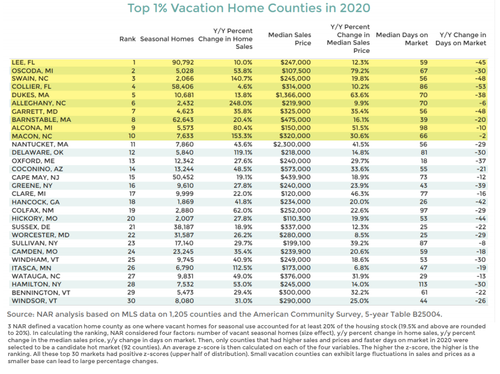
Here Are America's Top Ten Vacation Home Counties

(Source: zerohedge.com) 

BY TYLER DURDEN

TUESDAY, JUN 22, 2021 - 07:45 PM

A new report from the National Association of Realtors said the housing market is "hot in vacation home counties than nonvacation home counties."

NAR's 2021Vacation Home Counties Report examined more than 1,000 counties across the US using Multiple Listing Service data and found the top % vacation home counties in 2020. These counties are scattered across 16 states and met the criteria for being in the top 1%, including higher price, higher sales growth, and faster days on the market.

"North Carolina had four vacation counties (Swain, Alleghany, Macon, Watauga); there were three each in New York (Greene, Sullivan, Hamilton), Vermont (Windham, Bennington, Windsor), Massachusetts (Dukes, Barnstable, Nantucket), and Michigan (Oscoda, Alcona, Clare); there were two each in Florida (Lee, Collier), Missouri (Hickory, Camden), Maryland (Garrett, Worcester). Oklahoma, Maine, Arizona, New Jersey, Georgia, New Mexico, Delaware, and Minnesota each had one vacation home county that landed in the top 1% list," NAR said.


"Vacation homes are a hot commodity at the moment," said Lawrence Yun, NAR's chief economist. "With many businesses and employers still extending an option to work remotely to workers, vacation housing and second homes will remain a popular choice among buyers."

Much of the boom has been fueled by the pandemic, as city-dwellers panic left cities for rural areas with scenic views or natural wonders. Also, mortgage rates at record lows unleashed a flurry of buyers while these homes were in short supply.

However, the monetary wizards at the Federal Reserve suggested last week that interest rate rises and tapering their massive balance sheet could occur sometime next year. This could derail not just the vacation home boom but the overall housing market.

Federal Reserve Bank of Dallas Robert Kaplan played bad cop Monday morning as he suggested: "whether the housing market really needs the Fed's support of $40 billion a month."

London’s Rental Market Heats Up

(Source: propertywire.com) 

18 JUNE 2021 

AUTHOR: PETE CARVILL

PROPERTY NEWS,UK


London’s rental market is witnessing a strong recovery in spite of the pandemic, according to Chestertons’ latest analysis. Comparing May to April, the agency’s 31 branches across London confirmed a cumulative 17 per cent increase in new tenant registrations and 10% increase in agreed lettings.

Whilst demand is up, the number of properties available to rent at the end of May 2021 was down, with Chestertons registering a 3 per cent reduction in supply compared to end of April 2021 and a staggering 24 per cent reduction compared to May 2020. With demand outstripping supply, fewer landlords are now willing to drop their rents which is a stark contrast to this time last year when high numbers of London landlords dropped their rents by up to 20 per cent.

In fact, Chestertons confirms that in many London postcodes, rents increased in May vs April. Some of the areas that have seen the biggest rental increase are Barnes (+17 per cent), Wandsworth (+15 per cent), Mayfair (+23 per cent), Westminster (+18 per cent) and South Kensington (+12 per cent).

Richard Davies, Head of Lettings at Chestertons, says: “The majority of tenants registering with us now see their return to the office as imminent; whether that’s full or part-time. With that in mind, and with rents at the lowest level they have been in years, tenants are rushing to snap up a London rental property at a reduced cost. At the same time, as lockdown restrictions are easing and travel becomes possible again, we are also seeing the return of overseas student demand. With the continuous increase of tenants wanting to move back to London, we expect London’s rental market to become increasingly competitive over the next few months; particularly during the summer, which has always been a key season for tenants to move.”

Lumber is showing us the future

(Source: finance.yahoo.com)  

Myles Udland·Anchor
June 15, 2021


A transitory surge cools off.

Two months ago it took only one thing to be rich.

And that was a piece of lumber.

Through the spring, the surge in lumber prices became the market narrative as it covered every pandemic-related trend: Labor shortages, shipping constraints and housing demand — all in one place.

But now it looks like the latest mini-bubble to hit the market has started to pop, and offers us a preview of what's to come across the economy.

On Monday, the lumber futures contract traded back below $1,000 per thousand board feet for the first time since late March. A level that is still elevated to be sure, but back in line with pandemic-era peaks seen in late summer 2020, and the early winter of 2021 (before the spring's epic short squeeze).


Lumber futures are down almost 40% from their record high hit in mid-May as the latest mini-bubble within the economy cools off. (Source: Yahoo Finance)

Lumber futures are down almost 40% from their record high hit in mid-May as the latest mini-bubble within the economy cools off. (Source: Yahoo Finance)

During the housing bubble, the futures contract for random length lumber never traded above $500 per board feet. But by early May, lumber futures were trading hands for more than $1,600 per board feet. This surge was adding as much as $36,000 to the cost of a new home; on average, new homes sell for around $400,000.

So while Cathie Wood may have become the face of the pandemic stock market rally, actual wood had become the market's hottest trade.

We've called this recovery the "not enough" economy as demand for almost everything — workers, vacations, dinner reservations, and so on — outstrips supply. Another way to slice this narrative is, as Bloomberg's Joe Weisenthal has argued, to call this an economy facing a series of short squeezes.

Used car prices, for instance, have been ripping higher as demand rises and supply is constrained. The used car market is, in essence, facing a short squeeze.

So too is the global shipping market, as Insider's Rachel Premack outlined in a piece last week. And on the housing side, economist Ali Wolf told Bloomberg recently there's been something of a "buyer's protest" in the market as prices for single-family homes in the U.S. have exploded over the last year.

But each of these markets — autos, shipping, housing, among others — has become imbalanced, because of one-time surges related to a dramatic and synchronized shutdown, and then re-opening the world's largest economy.

When the Fed says inflation pressures will be "transitory," what they mean is that prices across each of these categories facing short squeezes right now will start to make more sense. It just so happens that lumber is just showing us the way.

Gen Z Is Eager For Homeownership, Only Not At The Moment: Report

(Source: benzinga.com)  

Phil Hall , Benzinga Staff Writer
 June 24, 2021 

A new potential homeowners survey by Realtor.com finds the Gen Z demographic is eager to enter the housing market, albeit in the near future and not today.

What Happened: According to the survey, nearly two-thirds of Gen Zers – individuals between the ages 18 and 25 – said their experiences during the COVID-19 pandemic did not impact their homeownership plans, with more than one-quarter stating the pandemic made them feel even more strongly about buying a home.

Among aspiring Gen Z homeowners, 43% said they planned to become homeowners within the next five years and 44% expected to enter the housing market within the next five to 10 years. Long-term, 49% of future Gen Z homebuyers planned to establish a suburban residency and 19% were looking forward to a rural property, with the remaining one-in-three forecasting an urban city life.

What Else Happened: However, when asked why they weren't buying a home now, half of the youthful respondents said job stability was their barrier. But while only 43% of the Gen Z respondents were currently employed, 45% of those surveyed said they were already saving toward buying a home.

George Ratiu, senior economist at Realtor.com, observed that while this demographic “values homeownership,” time is not their ally at the moment.

“The oldest members of this generation are just entering the professional stage of life and not yet in a financial position to make a big play as first-time buyers – especially in the current housing market, which is challenging even older generations who have had many more years to save for a down payment,” he said.

“With nearly three-quarters of those surveyed preferring to buy versus renting long-term, the housing industry should be prepared for millions of Gen Z buyers to bring a new wave of demand along a similar stage-of-life timeline as the millennial generation before them.”

Houses are only on the market for less than a week: report

(Source: foxbusiness.com)  

A new report says that houses are only taking a few days before going under contract

June 20, 2021

By Michael Hollan | FOXBusiness

Six days really isn’t a long time.

The real estate market is going through a record-breaking phase which has been described as "red-hot" by a recent housing report. According to that same report, houses are under contract, on average, less than a week after being listed.

A new report from real-estate listing company Zillow says that houses are staying on the market just six days before being bought. The report was based on information collected during the month of May.

The report found that in some markets (Cincinnati, Kansas City and Columbus), some homes are only spending an average of three days on the market before going under contract. The report describes the time homes are spending on the market as record lows.

The average time on the market for houses reportedly dropped by a day from April.

At the same time, the housing market saw an increase in inventory from the previous month. Zillow found that there was a 3.9% increase from April to May. This reportedly marks the first increase since July 2020.

Inventory is reportedly still down nationwide from where it was a year ago, with a decrease of 31.2%. While inventory dropped nationwide, there have been increases in specific markets, including San Jose, San Francisco and Milwaukee (three of the nation’s largest markets).

For now, it might seem like it’s the perfect time to sell a home. Before the pandemic struck and impacted the market, however, evidence suggested that there was a specific window of time that homeowners should list their homes.

As Fox Business previously reported, data suggests that the best time to list a home was a Thursday before Labor Day. Meanwhile, Sunday was often considered the worst day of the week to list a home.

Fox Business' Cortney Moore contributed to this report.

For Sellers Looking to Offload Large Homes, These U.S. Cities Have the Strongest Markets

(Source: mansionglobal.com)  

Demand for space is up across the country, but cities like Anaheim, California; Houston, Denver and Phoenix are seeing especially robust activity on large properties

BY VIRGINIA K. SMITH | ORIGINALLY PUBLISHED ON JUNE 25, 2021 | MANSION GLOBAL


It’s no secret that the Covid-19 pandemic abruptly changed patterns of buyer demand across the U.S., halting a years-long trend toward minimalism and small spaces in favor of large, compound-style properties with plenty of private rooms and outdoor space.

“People have spent so much more time in their homes and have been working from home, and a lot of them see the value in having a home office, a big backyard, or just having more space in general,” said Daryl Fairweather, chief economist at Redfin. “I’m not sure if we’re going to see a reversal when things open up and people start going out and spending money on vacations again.”

The effect is especially pronounced in certain cities—often areas with easy proximity to larger, more crowded metro areas, or those that simply offer larger properties for lower prices.

According to data compiled for Mansion Global by Redfin, between April 12 and May 9, the largest year-over-year increases in the median square footage of pending sales were seen in Anaheim, California, with a 5.9% increase; Riverside, California with a 4.1% increase; Houston with a 3.4% increase; Los Angeles with a 3.2% increase; Denver with a 2.6% increase; and Phoenix with a 2.5% increase.

“Thinking through all the clients we’ve helped in the last year since Covid hit, I don’t think a single one downsized,” said Jennifer Wauhob of Better Homes and Gardens Real Estate Gary Greene in Houston. “They’ve all ideally wanted more space, and people are not necessarily having to base where they live on where their office is.”

And while prices have gone up in nearly all categories, the outsized demand for larger properties has in turn had an outsized effect on pricing.

“It really is the largest homes that have gone up the most in value,” Ms. Fairweather said. “That’s why it’s so difficult for buyers to move up. If you’re moving from a three-bedroom to a four-bedroom, you’ll make a lot on the three-bedroom, but the price increase on the four-bedroom is more.”

The flip side of this dynamic is that for sellers considering downsizing, or sitting on large properties that might have had difficulty selling in previous years, the current market dynamics are squarely in their favor.

“If you’re going from a three-bedroom house to a condo, condo prices have been pretty much flat, so you can take all of that profit and get a relatively good two-bedroom at a good mortgage rate,” Ms. Fairweather said.

For sellers contemplating the sale of large properties in these high-demand areas, here’s what to know to take advantage of the current frenzy for square footage.


Wealth From Large Cities Continues to Spread

Even as Covid infection rates drop and pandemic-related restrictions are lifted, wealthy residents of major cities continue to move to more spacious outlying areas, or to farther-flung, lower-cost states in search of larger homes and room to spread out.

“Last summer we started getting calls from buyers in New York and California in particular,” said Jay Monroe of Martha Turner Sotheby’s International Realty in Houston. “They were coming because they could now work from anywhere, and were choosing Houston because we tend to have more space. You can get a 4,000-square-foot house here on a 10,000- or 20,000-square-foot lot for the same price that you’d get an apartment in Manhattan.”

In Orange County, California—home to both Anaheim and Riverside—huge volumes of wealth are coming from Los Angeles County as well as the Bay Area, as luxury buyers, no longer tethered to daily commutes, move outside of some of the state’s most populous cities.

“People are looking for [areas] that are less crowded, have more space, they can work from home and don’t mind driving into Los Angeles once or twice a week as opposed to five days a week,” said Mike Hickman, CEO of Seven Gables/Luxury Portfolio International in Orange County. “And the Bay Area is less than an hour flight from Orange County. It would be like living in Brooklyn and moving to the Hamptons or upstate New York, somewhere you have a lot of space.”

The influx of demand from buyers in more expensive cities is compounded by the desire of existing area residents to upsize as much as possible.

“Even within Houston, I’ve seen so many people moving out of townhomes and apartments,” Mr. Monroe said. “Their first home was a townhome with a patio, but now that seller wants to move to a bigger single-family home on its own lot. And the seller of that lot is moving to a property that’s a full acre. So there’s a domino effect.”

All of which translates into buyers clamoring for larger properties, and paying increasingly higher prices to get them.

“We’re seeing crazy high prices and record-low inventory,” Ms. Wauhob said. “Families are getting so much more house for their money here that they think, ‘Let’s go big.’”


A Swift Change of Fortunes for Owners of Large Properties

While low inventory for these in-demand properties is in no small part driven by owners who have hung onto them for their own use during the pandemic, for those who are willing to consider a sale, this is a particularly opportune moment.

“We went through a phase where I really saw demand for under 7,000 or 6,000 square feet,” said Allan MacDonald, an agent with Sotheby’s International Realty in Scottsdale, Arizona. “There was a period where it was awfully difficult to sell the super large estate homes, and we trended toward smaller properties with one great room.”

Mr. MacDonald added, “If you look at the luxury markets here since Covid, we’ve had so many homes that have sold over 10,000 square feet. A lot of people who probably thought three years ago that they were stuck with a $6 million or $7 million house they couldn’t sell have been able to sell for $8 million or $9 million in this market.”

As a result, with lockdowns largely lifted in most cities, some sellers are now jumping into the market to take advantage while the trend toward “bigger is better” lasts.

“There have been some really savvy sellers who ended up having a significant windfall because of what has happened in the past 10 months,” said Cameron Ansari of Greenwood King Properties/Luxury Portfolio International in Houston. “Frankly, we’ve seen people come into a new market area and overpay, in cash, with no appraisals. This can only go on so long.”

As the year wears on, this dynamic might result in more balanced inventory for large properties, and increased competition for sellers.

“A lot of our downsizers held on [during the pandemic] and are going to downsize this year,” said Amy Cesario, an agent with Compass in Denver. “The ones that were going to list last summer decided to put off their sale and wait until after the pandemic. They’ll start [to list] and change what we’ve seen in the past 12 months.”

And while demand for larger properties in these cities isn’t likely to do a swift about-face any time this year, for owners looking to sell at an optimal moment, this is an unquestionably strategic moment to take the plunge.

“It’s certainly a very financially savvy decision to make at this moment in time,” Ms. Fairweather said. “Because large homes are so in-demand, if you’re downsizing, now is a great time to do it. I don’t think a lot of people are doing that, because everybody seems to want larger homes, but everybody who is is making out really well.”

The most recent dish... enjoy!

How the IRS is trying to nail crypto tax dodgers

(Source: cnbc.com )  PUBLISHED WED, JUL 14 2021, 12:08 PM EDT; UPDATED THU, JUL 15 2021 2:00 PM EDT MacKenzie Sigalos  @KENZIESIGALOS KEY PO...

Popular Dishes