Showing posts with label Business. Show all posts

Artificial Intelligence Has Caused A 50% To 70% Decrease In Wages—Creating Income Inequality And Threatening Millions Of Jobs

(Source: forbes.com)  

Jun 18, 2021,
Jack Kelly, Senior Contributor

The middle and working classes have seen a steady decline in their fortunes. Sending jobs to foreign countries, the hollowing out of the manufacturing sector, pivoting toward a service economy and the weakening of unions have been blamed for the challenges faced by a majority of Americans.

There’s an interesting, compelling and alternative explanation. According to a new academic research study, automation technology has been the primary driver in U.S. income inequality over the past 40 years. The report, published by the National Bureau of Economic Research, claims that 50% to 70% of changes in U.S. wages, since 1980, can be attributed to wage declines among blue-collar workers who were replaced or degraded by automation.

Artificial intelligence, robotics and new sophisticated technologies have caused a wide chasm in wealth and income inequality. It looks like this issue will accelerate. For now, college-educated, white-collar professionals have largely been spared the fate of degreeless workers. People with a postgraduate degree saw their salaries rise, while “low-education workers declined significantly.” According to the study, “The real earnings of men without a high-school degree are now 15% lower than they were in 1980.”

Much of the changes in U.S. wage structure, according to the paper, were caused by companies automating tasks that used to be done by people. This includes “numerically-controlled machinery or industrial robots replacing blue-collar workers in manufacturing or specialized software replacing clerical workers.”

Artificial intelligence systems are ubiquitous. AI-powered digital voice assistants share everything you want to know just by asking it a question. Instead of a live person addressing a problem, a corporate chatbot forces you to engage with it. The technology is remarkable. It helps diagnose cancer and health issues. Banks use sophisticated software to check for fraud and bad behaviors. Driverless automobiles, newsfeeds, social media and job applications are all controlled by AI.

The World Economic Forum (WEF) concluded in a recent report, “A new generation of smart machines, fueled by rapid advances in AI and robotics, could potentially replace a large proportion of existing human jobs.” Robotics and AI will cause a serious “double-disruption,” as the pandemic pushed companies to fast-track the deployment of new technologies to slash costs, enhance productivity and be less reliant on real-life people. The WEF asserts automation will slash about 85 million jobs by 2025. In a dire prediction, WEF said, “While some new jobs would be created as in the past, the concern is there may not be enough of these to go round, particularly as the cost of smart machines falls over time and their capabilities increase.”

Management consulting giant PriceWaterhouseCoopers reported, “AI, robotics and other forms of smart automation have the potential to bring great economic benefits, contributing up to $15 trillion to global GDP by 2030.” However, it will come with a high human cost. “This extra wealth will also generate the demand for many jobs, but there are also concerns that it could displace many existing jobs.”

Concerns of new technologies disrupting the workforce and causing job losses have been around for a long time. On one side, the argument is automation will create new and better jobs and erase the need for physical labor. The counterclaim is that people without the appropriate skills will be displaced and not have a home in the new environment.

Amazon, Google, Microsoft, Apple, Zoom and other tech giants greatly benefited financially during the pandemic. The virus outbreak accelerated trends, including choosing technology over people. There’s still a need for humans. For example, although Amazon invested heavily in automation for its warehouses, the online retail giant still needed to hire over 300,000 workers during the pandemic. This brings up another important overlooked issue: the quality of a job. Proponents of AI say that there’s nothing to worry about, as we’ve always successfully dealt with new technologies. You may have a job, but what is the quality of it?

To remain relevant, you will have to learn new skills to stay ahead of the curve. Bloomberg reported, “More than 120 million workers globally will need retraining in the next three years due to artificial intelligence’s impact on jobs, according to an IBM survey.” The amount of individuals who will be impacted is immense.

The world’s most advanced cities aren’t ready for the disruptions of artificial intelligence, claims Oliver Wyman, a management consulting firm. It is believed that over 50 million Chinese workers may require retraining, as a result of AI-related deployment. The U.S. will be required to retool 11.5 million people in America with skills needed to survive in the workforce. Millions of workers in Brazil, Japan and Germany will need assistance with the changes wrought by AI, robotics and related technology.

For those who may be left behind, there’s a call for offering a universal basic income (UBI). This idea gained national attention when it became a major part of Democratic candidate Andrew Yang’s 2020 presidential campaign. Yang’s policy was to lift people out of poverty or help them through rough patches with a guaranteed monthly income. Supporters say it gives people needed financial security to find good jobs and avoid debt. Critics have argued free money would be a disincentive to work, creating a society dependent on the state.

According to a Wells Fargo research report, robots will eliminate 200,000 jobs in the banking industry within the next 10 years. This has already adversely impacted highly paid Wall Street professionals, including stock and bond traders. These are the people who used to work on the trading floors at investment banks and trade securities for their banks, clients and themselves. It was a very lucrative profession until algorithms, quant-trading software and programs disrupted the business and rendered their skills unnecessary—compared to the fast-acting technology.

There is no hiding from the robots. Well-trained and experienced doctors will be pushed aside by sophisticated robots that can perform delicate surgeries more precisely and read x-rays more efficiently and accurately to detect cancerous cells that can’t be readily seen by the human eye.

Truck and cab drivers, cashiers, retail sales associates and people who work in manufacturing plants and factories have and will continue to be replaced by robotics and technology. Driverless vehicles, kiosks in fast-food restaurants and self-help, quick-phone scans at stores will soon eliminate most minimum-wage and low-skilled jobs.

The rise of artificial intelligence will make even software engineers less sought after. That’s because artificial intelligence will soon write its own software, according to Jack Dorsey, the tech billionaire boss of Twitter and Square. That will put some beginner-level software engineers in a tough spot. When discussing how automation will replace jobs held by humans, Dorsey told Yang on an episode of the Yang Speaks podcast, “We talk a lot about the self-driving trucks and whatnot.” He added, “[AI] is even coming for programming [jobs]. A lot of the goals of machine learning and deep learning is to write the software itself over time, so a lot of entry-level programming jobs will just not be as relevant anymore.”

When management consultants and companies that deploy AI and robotics say we don’t need to worry, we need to be concerned. Companies—whether they are McDonald’s, introducing self-serve kiosks and firing hourly workers to cut costs, or top-tier investment banks that rely on software instead of traders to make million-dollar bets on the stock market—will continue to implement technology and downsize people, in an effort to enhance profits.

This trend has the potential to adversely impact all classes of workers. In light of the study’s spotlight on the dire results of AI, including lost wages and the rapid growth in income inequality, it's time to seriously talk about how AI should be managed before it's too late.
How Salesforce Learned From Microsoft's Mistakes to Dominate in AI

(Source: fool.com)  

Here's why AI is likely to be an increasingly valuable competitive edge for Salesforce over the next four years.

Taylor Weldon (TMFTaylorWeldon)
Jun 22, 2021 at 10:31AM


salesforce.com's (NYSE:CRM) latest earnings report was the best in company history, according to CEO Marc Benioff. Investors didn't seem to disagree, as the cloud services company's stock price jumped 10% the day following the release and has sustained an upward trend since.

Still, one of the biggest pieces in Salesforce's growth story is talked about the least, both in earnings reports and otherwise. Salesforce built Einstein, the company's sales and productivity artificial intelligence (AI) bot, by studying ethical AI after Microsoft's (NASDAQ:MSFT) AI bot Tay infamously adopted offensive behavior in 2016.

Now, the company has market leadership in customer relationship management (CRM) and can utilize this foothold for data to improve its AI even further in the sales productivity space. With AI spending poised to skyrocket, Salesforce is already ahead of the game in market share and ethical technology.


AI's place in the growth story

Salesforce still has room to grow, and the company continues to add complementary offerings to its Customer 360 platform (i.e., its core business). Although Salesforce holds the No. 1 spot in the CRM industry by far, that leadership position translates to only 20% of the market -- indicating much more room for growth in Salesforce's core business.

Looking long term, global AI spending is slated to double in the next four years. Salesforce could use its market leadership in CRM to lead the market in providing sales and productivity AI solutions in the U.S. as this transformational market-doubling AI revolution occurs.

Salesforce recognizes that ethics are critically important in scaling AI solutions -- a lesson learned from Microsoft's chatbot (called "Tay") in 2016. When Microsoft gave the chatbot a platform on Twitter, the AI quickly "learned" from its surroundings and began posting tweets that were almost entirely hateful and offensive.

Granted, Microsoft intended to deploy Tay as an experiment. Still, her brief time exposed to real human conversations -- both good and bad -- was a shocking example of AI "conversational understanding" gone very wrong. Companies should understand that developing AI is not just a technical endeavor, but a profoundly social one as well.


Why Einstein has the edge

Put simply, Salesforce currently has the edge in sales intelligence AI because it beat Microsoft and other major players to the punch by several years in providing low-code sales AI solutions. Further, Salesforce's massive market share and impressive customer retention (typically above 90%) make it harder for competitors to catch up now that they're behind.

This time-to-market argument is especially true for software-as-a-service (SaaS) companies like Salesforce, because switching costs tend to be high compared to other industries. When an entire team is trained on using one platform, the cost to switch to another can be steep as it involves lost productive time, time spent migrating information, and time spent training employees on the new software.

As far as the technology goes, Salesforce's client base is a major benefit in training Einstein to be smarter, build more use cases, and increase customer value. The more data that AI has to learn from, the faster it will improve and make more predictions -- such as forecasting which sales leads are most likely to convert, how a chatbot should respond to a customer inquiry, and which email send times are optimal based on customer data.


How ethics can help Einstein keep the edge

As Einstein scales, it is likely to be more equipped than the competition in adhering to ethical AI principles. Salesforce has employed a dedicated AI ethics team since 2018, shortly thereafter opening its Office of Ethical and Humane Use and hiring its Chief Ethical and Humane Officer.

These positions and offices are not just for show -- Salesforce has done the research on ethical AI and has the technology to prove it. One example of this is Einstein's "sensitive features" fields, which allow an admin to indicate which fields are "sensitive," meaning they may add bias to a model, like age, race, or gender. Einstein then looks for fields that are highly correlated with the sensitive fields and flags them for review.

This process effectively avoids unintended bias, such as a bank using ZIP codes as a factor in determining eligibility for a loan -- the ZIP codes in question could be unknowingly correlated with race or age.

Microsoft is in no way ignoring the gravity of ethical AI, but again, Microsoft lags behind Salesforce in time to market. Microsoft's Office of Responsible AI was opened just last year as part of its existing Corporate, External, & Legal Affairs (CELA) branch. So, Microsoft is not just late to the space compared to Salesforce -- it is late to developing ethical AI applications that are critical to building customer trust and retention.


Is it a buy?

Trading at a price-to-sales ratio of 9.93, Salesforce stock is a cheaper buy than competitors like Microsoft, HubSpot (NYSE:HUBS), and Adobe Systems (NASDAQ:ADBE). The stock is priced to buy and hold while its CRM and AI applications develop.

Keep in mind that Microsoft and Adobe have a developing partnership with C3.ai (NYSE:AI) focused on AI in CRM. The trio lags far behind in market share, and the product they offer is industry-focused, narrowing its potential customer base. However, this powerful partnership will be one to watch.

As long as Salesforce continues gaining market share and Einstein gains more ethical use cases, the company should maintain its position as the dominant force in CRM solutions. As AI applications become a more prominent factor in this space over the next four years, Salesforce is ready at the wheel to get the job done right.

How AI complicates enterprise risk management

(Source: venturebeat.com)  

Arthur Cole
June 18, 2021 4:40 PM


Despite the gains artificial intelligence has already brought to the enterprise, there is still much hand-wringing over its potential for unintended consequences. While the headlines tend to focus on AI running amok and destroying all mankind, the practical reality is that current generations of AI are more likely to wreak havoc on business processes — and profits — if not managed properly.

But how can you control something that, by its nature, is supposed to act autonomously? And by doing so, won’t the enterprise be hampering the very thing that makes AI such a valuable asset in the workplace?


AI gone wrong

OnCorps CEO Bob Suh offers a good overview of the harm AI can cause, even when employed with the best of intentions. The experiences of the social media platforms illustrate how poorly designed algorithms can produce one set of positive results (more sharing) while at the same time promulgating negative results (misinformation and manipulation). It’s fair to say that executives at Facebook and Twitter did not intend for their platforms to foster society-wide conflict and animosity, but they did focus their efforts on maximizing profits, so that is what their reinforcement learning agents (RLAs) did.

RLAs are based on simple reward functions in which positive results prompt the agent to expand and refine its actions. Without a countervailing reward mechanism, the agent will continue to get better at what it does even if it no longer produces a desirable outcome. In this way, the social media bots were highly successful at achieving their programmed objectives even as they were being manipulated by some in the user community to weaponize public opinion and sow discord throughout the population.

These same problems can emerge in sales, marketing and other functions. And unfortunately, few organizations are equipped to identify and correct algorithms that are driving undesirable outcomes until the damage is done. This can take the form of everything from lost revenue and missed market opportunities to security breaches and damage to internal structures and processes.

At its heart, implementing the proper controls on AI is a form of risk management. Due to its autonomous nature, however, AI requires a little more attention than standard IT, say McKinsey partners Juan Aristi Baquero, Roger Burkhardt, Arvind Govindarajan, and Thomas Wallace. For one thing, AI introduces a number of unfamiliar risks across a multiple disciplines, including compliance, operations, legal, and regulatory. Banks, for example, have long worried about bias from their human employees, but if those employees start making recommendations based on what a biased AI tells them, now the institution has systematized that bias into its decision-making process.

Another problem is the way AI is rapidly becoming decentralized across the enterprise, which makes it difficult to track and monitor. And as the various AI implementations of multiple vendors, partners, and other entities start to communicate with one another, the potential to introduce new risks increases. A new tool within a vendor’s CRM platform, for example, could create data privacy and compliance risks across multiple geographical regions.


Up-front management

The best way to manage these risks is to implement the proper controls before AI becomes woven into the fabric of the enterprise, according to Todd Bialick, digital assurance and transparency leader at PwC. To do that, you’ll need to conduct a full-stack review of everything AI touches as it seeks to fulfill its mandate. This includes data-layer policies governing input and set selection, oversight and transparency in algorithm and model development, continual review of output and decisions, and full control over logical security, compute operations, and program change and development.

Training AI to behave ethically is also an emerging, yet extremely nascent, field that has drawn the interest of both private- and public-sector organizations. One of the key difficulties is that ethics is a very subjective discipline, in which ethical actions in one set of circumstances can be unethical in another. But as James Kobielus, senior director of research for data management at TDWI, points out, ultimate ethical responsibility must remain with humans, not with inanimate objects, no matter how intelligent they seem. To prevent AI from “going rogue,” it should always incorporate human interests as a core element, and this can manifest itself in everything from the decisions it makes to the way it looks. As well, transparency in AI inferencing lineage may be necessary to ensure there is an audit trail back to the humans who created it.

In the end, of course, managing AI is a matter of trust. Organizations would be wise to treat AI just like any other employee: Give it a limited set of responsibilities, see how it performs, and then promote it to higher levels of authority after it has proven itself both capable and worthy. Just like you don’t appoint a recent graduate as your new CIO, you don’t place AI in charge of C-level sales management or HR.

While the risk of unintended consequences can never be reduced to zero, the odds are good that in some way, somehow, humans and AI will find a way to work together. And since both forms of intelligence provide strengths that compensate for the other’s weaknesses, it is more than likely their relationship with be mutually beneficial relationship, not hostile.

Why Adopting Artificial Intelligence is Vital for the B2B Industry

(Source: business2community.com)  

Tuhin BhattJune 30, 2021


A lot has happened in the AI segment in the preceding year. Experts have in fact called it ‘The Power of Now’. AI is rapidly turning into a need for B2B organizations, as it can help convey information driven and significant bits of knowledge to associations. At the point when Artificial Intelligence is used with online business, the advantages that can be picked up are huge.

According to a survey conducted by PROS in collaboration with Hanover Research;

  • 45% of respondents believe that AI can help in improving customer service
  • 44% of respondents believe that AI can help in meeting customer demands
  • 42% of respondents believe that AI can help in increasing revenue
  • 41% of respondents believe that AI can help in achieving cost savings
  • 39% of respondents believe that AI can help in gaining an advantage over competitors
  • 39% of respondents believe that AI can help in enhancing operational efficiency
  • 73% of respondents believe that AI can help in boosting sales and marketing activities
  • 48% of respondents believe that AI can help in compete in today’s market

AI and its role in the B2B industry

The rate of Artificial Intelligence adoption by sales and marketing channels might probably be get driven due to the fact that B2B organizations can utilize AI to apply AI systems to client choices. By making the increasingly customized item and cost proposals, associations can additionally upgrade the general client experience, while as yet keeping up aggressive cost contributions that assistance your business remain gainful.

Being able to customize alternatives to address purchaser issues and purchasing practices enable businesses to make unwaveringness, as happy clients will be bound to return on numerous occasions over the long haul.

Here are a few ways in which adopting Artificial Intelligence can prove to be vital for the B2B industry. Let’s have a look;

Actionable Insights For Sales Team:

We can’t deny that automation of marketing has its points of confinement since ordinarily just a business delegate can at long last have a 1:1 discussion and close a lead. Marketing teams can empower the sales team by giving important bits of knowledge about prospects, all through the business cycle using Artificial Intelligence.

The business associates can be furnished with data about hierarchical and industry elements, distinguishing proof of key leaders and key prospects, and they can likewise share data about the dimensions of commitment. This significant association between the marketing team and sales department is an uplifting viewpoint since the sales team can now handle this data and concoct noteworthy bits of knowledge.

Forrester created some excitement in 2015 when it discharged a report evaluating 1 million B2B deals work being disposed of by 2020. AI is never going to be a swap for the experts, rather, it is the innovation of the present and future which is just going to push deals experts to ‘level-up’ their diversion. Artificial Intelligence will undoubtedly prove to be of great help to the sales team by letting them focus on their tasks seamlessly by using data science and analytics.


Automated Operations:

Too much time of a sales rep’s day by day exercises is spent doing dreary assignments, for example, cold pitching, reacting to messages and so on. Enter AI and the assignments mystically decrease. As indicated by McKinsey Global Institute, 40% of the time spent on modest errands, for example, these can be mechanized by receiving all the present innovations that AI brings to the table.

Inserting AI into Salesforce computerization programming, CRM databases, other B2B applications and a great deal of these devastating undertakings can be dispensed with for good. AI can free sales reps from such dreary assignments, and the beneficial outcomes of this strategy are broad along these lines inspiring the undertaking higher than ever.


Improved Customer Experience:

For organizations, customers are genuine saints and work as a motivation for building up new channels of interchanges created through novel advancements. There is no better spot for organizations to put resources into Artificial Intelligence arrangements than client administration and commitment.

The proactive utilization of Artificial Intelligence robots and calculation will empower B2B advertisers to collect and arrange more information to legitimately soak up the working of their current business organize made up of clients, providers, accomplices, merchants, and advertisers.

From expectation to personalization, advertisers will most likely touch all spaces of brand promoting through the 360-degree route of clients’ propensities, inclinations, driving forces, unordinary soul and purchasing behaviors.

Most recent reports on customer explore additionally recommend that 80% of B2B advertising officials trust that Artificial Intelligence in B2B promoting will reform the field totally in the following five years.


Chatbots and Your Brand:

With the presentation of Amazon’s Echo, Alexa, and Dot, just as Google Home, AI has made an unmatched space in the world around us. As these ‘options to the family’ associated with different innovations around the house and adjust to buyer propensities, every collaboration will be viewed as a chance to recommend potential item and service add-ons.

An example of this can be, LG’s SmartThinQ home computerization center, which works with Alexa to decide how much cleanser you use, and requests more when you’re running low.

Having said this, incorporating a Chatbot app development plan can indeed be of great help to make that much-needed space in the hearts of your target audience. Not only this, but the same can also help you attract, engage, and earn the goodwill of your target audience.


Maximize Efficiency:

One of the loathsome difficulties of showcasing is streamlining the cost included. With the whole business religion getting on the web, Artificial Intelligence sounds like an incredible decision to handle showcasing challenges relating to cost.

Since AI’s profound learning capacity includes negligible human power, such computerized framework can diminish significant measure of costs simultaneously while likewise expanding work productivity.

This remarkable methodology in the computerized showcasing circle additionally decreases business correspondence cost further since clients get pre-programmed messages and machine-empowered proposals on most recent offers by means of messages, online promotions, push messages or internet based life posts.


Conclusion

Without a doubt, Artificial Intelligence is the present and the future of growth in B2B Industry. All the functional used cases recommend that AI can be of unmatched help to make continuous prescient models and adequately draw in with clients while at the same time increasing the upper hand.

Advertisers will reap new open doors by utilizing man-made reasoning in B2B deals and showcasing by being an extraordinary storyteller. Experts believe that AI will push the limits of imagination and making intelligent client experience that will at last boost your business.

Report: Store closures decline for the first time in 2021

(Source: retaildive.com) 


Published June 28, 2021

Ben Unglesbee
Senior Reporter


Dive Brief:

For the first time in 2021, store closures have declined year over year, according to an emailed report from Coresight Research.The firm tracked 4,626 closures so far this year, 5.7% fewer than last year at this time. Leading retailers in closures so far is Christopher & Banks, which liquidated its physical footprint in bankruptcy this year. Another recent retail bankruptcy, Francesca's, closed 342 stores, a significant chunk of its footprint.Openings to date stand at 4,311, a 41.8% increase over the same period in 2020. The runaway leader in openings is Dollar General, with 1,035 new stores this year, followed by Dollar Tree with 393 openings.


Dive Insight:

After a harrowing pandemic and global recession, retail had few places to go in 2021 but up. From earnings of individual companies to U.S. Census sales reports, there is reason for hope across the industry.

Coresight's latest report is another data point showing how retail is recovering from the wretched year of 2020. Earlier this year, for a moment, openings even outpaced closures, according to Coresight. As the year has worn on, closures have overtaken openings again, however.

Still, the surge in openings this year compared to last is a sign that retailers are confident in the future of their business, including in brick and mortar, despite the lingering impact of the pandemic and shifts among consumers toward more digital shopping.

While Dollar General and other dollar stores, including Dollar Tree and Five Below, account for more than a fourth of all openings, a whole range of retailers are opening new shops. Burlington, Tractor Supply, Ross Stores, the revived Payless, Old Navy, Target, Ulta, Nike, the revived Charming Charlie and many others have all opened stores this year, according to Coresight.

As for the slowed pace of closures this year, one reason is likely the similarly slowed pace of retail bankruptcies, which often dominate the ranks of closures. Major retail bankruptcies tracked by Retail Dive had already hit 15 by this time last year, and many of them closed stores or liquidated entirely. That figure is almost twice the number of retailers that have filed for bankruptcy so far this year.

Retailers both healthy and distressed have been lifted by the vaccine rollout, government stimulus, booming financial markets — which have been crucial for keeping weaker retailers afloat — and a general return of customers to stores.

New Report Finds 80% of Small to Medium-Sized Businesses Say Cybercrime is a Greater Threat Today than in the Past Year

(Source: businesswire.com) 

Seventy-six percent consider the cloud a safe alternative to on-premise storage, up from 71% in 2019


June 22, 2021 09:00 AM Eastern Daylight Time


FORT WORTH, Texas--(BUSINESS WIRE)--ECI Software Solutions, a leader in cloud-based business management solutions, today released its 2021 State of SMB Digital Transformation report. The report details the findings from an independent survey commissioned by ECI examining how small and medium-sized businesses (SMBs) are leveraging technology to respond to the various threats from the past year—including cybercrime—while laying the groundwork for not only a post-pandemic economy but a more secure, resilient future.

SMBs ranked cybercrime as one of the top five threats their businesses face. Given the number of recent high-profile cyberattacks, it’s clear that cybersecurity vulnerability will continue to threaten business resilience as the market moves toward post-pandemic recovery. According to the results, 80% of SMBs believe cybercrime is a greater threat than in the past and 74% have updated their security software to ensure their company doesn’t fall victim to a cyberattack.

For those that have suffered from a cyberattack, 90% report the attack impacted their business; 48% were forced to shut down operations for at least a day, 35% shut down for a week and 41% lost money. Twenty-six percent of respondents say they still have not fully recovered from their cyberattack.

To protect themselves, 76% of SMBs believe the cloud is a safe alternative to storing data on premise. Nearly half of SMB respondents are taking action and turning to the cloud as a cybersecurity measure, with 85% stating that their core business solutions—like enterprise resource planning (ERP)—are at least partially on the cloud.

While many organizations have taken strides and put best practices in place, many still doubt whether these measures are enough. Seventy-seven percent of SMB respondents believe their organization is doing everything it can to remain safe—yet 59% still think they’re at risk.

“SMBs don’t have it easy today. On top of the challenges created by the pandemic, the high profile cyberattacks on airlines, Colonial Pipeline and even NATO show that every organization is vulnerable,” said Trevor Gruenewald, CEO of ECI Software Solutions. “By working with technology partners like ECI, SMBs can further identify the risk and work together to make the investments that will help them focus on getting business done rather than looking over their shoulder for the next crisis.”


Other key findings include:

  • Technology adoption doubled in order to better manage business threats: Sixty-four percent of SMBs increased their technology investments in the nine months prior to and including Q1 2021, compared to only 32% in 2019, doubling the number of SMBs focused on growing their tech stacks.

  • ERP emerges as an essential solution for SMBs: For businesses that use it, ERP has emerged as an essential resource during these difficult times. Seventy-five percent of respondents say that ERP was either effective or very effective in helping them manage the impacts of the pandemic.

  • Cloud-enabled ERP helps with post-pandemic recovery: Despite being a longtime cornerstone for SMBs, ERP is far from a legacy product. Eighty-five percent of respondents report that their ERPs are wholly (35%) or partially (50%) in the cloud. The top benefit of a cloud-based ERP is improved data access from anywhere at any time (59%), followed closely by improved data security (57%), increased flexibility (57%) and improved productivity (56%). Again, each of these benefits is crucial in building a more resilient business for the post-pandemic economy.

6 Ways E-Commerce Startups Can Compete with Amazon Shipping (and Win)

(Source: startupnation.com)  

NICHOLAS DANIEL-RICHARDS
JUNE 21, 2021

Although it may seem like ages ago, many of us remember what an ordeal it was to order products online that were unavailable in our local stores. Back then, free shipping wasn’t available, and two-day shipping was exorbitantly expensive and reserved for nearly-forgotten birthday presents for the notoriously hard-to-please grandma. And if we needed pedestrian items like lightbulbs or toothbrushes, we would pencil in an immediate trip to Walmart. Fast forward to today, and we are not only ordering these items online, but Amazon Prime members can receive same day delivery in select areas.

With Prime, it seems that we can order nearly anything and have these items land on our doorsteps in two days or less. As a result, most of us are guilty of abandoning our carts on other sites after discovering that shipping isn’t free and it could take five to seven days to receive our orders.

Why would we want to pay extra and wait when we can just click on our Amazon app and receive the same product within two days?

This common consumer behavior is supported by the fact that 79% of consumers are more likely to shop online when there’s free shipping.


At this point, a year and a half into the COVID-19 pandemic, we all understand how vitally important it is not only for our businesses to be online, but to have an e-commerce component to our business: Consumers spent $861.12 billion online with U.S. merchants in 2020, up 44% year-over-year, according to Digital Commerce 360. Online spending represented 21.3% of retail sales, and this means that it is now essential for e-commerce startups to offer free, fast shipping.


Here are six things entrepreneurs can do to compete with Amazon Prime shipping to get orders out quickly and at low cost:


Influence the customer’s perception of speed

As soon as an order is shipped, an email with tracking information should be in the recipient’s inbox. Even if the order won’t arrive in two days, the knowledge that the product was shipped immediately will influence the shopper’s perception of shipping speed. The positive experience of knowing the order was shipped and the expectation of when the order will arrive increases the possibility of the customer returning for further purchases.


Get a shipping rate quote for each order

Shipping costs can vary widely among carriers, so it benefits business owners to search for the best price. When shipping many orders that are similar, you may benefit from group shipping methods based on the order type. When handling orders that have a variance of line items, manually rate quoting each order can be time consuming, which in turn causes orders to become backlogged. Instead, you should choose an optimized platform or program to quickly determine the cheapest option without holding up the order fulfillment process.


Build shipping costs into the order

It’s even possible to make money using this tactic, especially when choosing the cheapest option among shipping carriers. You can also review reports on how much was charged for shipping versus how much was actually paid. Typically, most warehouse management system solutions provide these shipment reports that chart the historical performance of orders that were shipped out.


Reduce the steps required to fulfill orders

When first starting out, many entrepreneurs tend to use paper lists to manually fulfill orders. However, this can be a slow and error-prone process, especially if the warehouse is disorganized or pickers are unfamiliar with the warehouse layout. Instead of paper pick lists, go digital. The best way to improve order fulfillment speed is to incorporate barcodes. Barcodes eliminate the guesswork involved in picking and packing orders and drastically reduce fulfillment errors. It’s extremely important to organize inventory and (if possible) use technology to optimize picking routes. This reduces walk time, and again further eliminates potential mistakes when picking items for orders.


Simplify the packing process

Generally, the cost of shipment is determined by either the weight or the package it’s shipped in (or both, depending on what the order is and where it’s going). While using scales at the time of packing seems like a logical step to determine the weight of the order, there are solutions that allow you to set the weight according to the product’s SKU or the weight and shipping method of each type of shipping container. This method, combined with a rate quote comparison for each shipment, will allow you to achieve a more efficient shipment cost per order when weight needs to be accounted for.


Add a touch of personalization

It’s definitely a challenge to beat Amazon’s speed and free shipping; and even if an entrepreneur is running a very efficient operation, it will still be a benchmark to reach. So, what else can a growing e-commerce startup do to compete?

You can add an additional experience for customers by personalizing the order.

For example, if you’re using Shopify, it’s possible to determine if a customer is a first time buyer or has ordered before. If you’re selling on Etsy, consider including a personalized, handwritten note thanking the customer for his or her order, or throw in a small freebie like a sticker or branded piece of swag. This personal touch makes a big impact on the customer, and is often more valuable than the expected shipment that arrives a little bit earlier.

Key takeaways

While it may be a challenge to beat Amazon’s two day (or same day) delivery as a new business, you can stay relevant by ensuring your shipping methods are fast, personalized and low-cost to your customer.

3 Steps For Managing Your Small Business’s Taxes

(Source: forbes.com)  

Jun 11, 2021,
Rhett Buttle

Filing business-related taxes can often be a time-consuming and complicated process, especially for new entrepreneurs. Small business owners need a good understanding of the federal, state, and local taxes required to file. The types of taxes can range from income, employment, excise, and sales.

It is critical that business owners are set up for success well before tax season. Here are three steps for managing your small business’s taxes. 

1. Find the Right Accountant 

Most small business owners hire an accountant to ensure that all tax filing and payments are made correctly. Accountants help reduce the amount of time business owners spend on taxes and booking. Generally, an accountant’s services can range from estimated tax payments to asset depreciation, and this investment in your business is vital to your long-term success. Accountants are constructive partners for your business and are essential members of the broader support team. There are many accountants in the market, but small business accounting requires specific expertise. Be sure to prioritize those specializing in small business accounting, especially those that have worked with businesses similar to your size and structure. The best place to get recommendations is from other business owners. Talk to similar or local businesses to ask for specific recommendations. 

2. Determine Your Tax Liability 

One of the first conversations you have with your accountant will be to determine your tax liability, which will guide how you file and pay your taxes. Each business tax liability is unique and is informed primarily by four factors: 1) business structure, 2) location, 3) asserts, and 4) number of employees. A business's structure will determine the type of federal income tax that a business will need to file and states and communities require businesses to file different types of taxes. In addition, the type and quantity of business assets (i.e., stock, equipment, property, etc.) may impact a business's overall tax liability. Businesses with employees will need to file employment-related taxes. Self-employed business owners will need to file a self-employment tax. 

3. Think Ahead to Avoid Common Mistakes

Beyond hiring an accountant, businesses can do a few additional things to avoid some common mistakes. For example, most small businesses are going to need to pay estimated taxes. Be sure to mark your calendar each year for the four quarterly estimated tax payments. In addition, keeping accurate records is a good business practice, but this also helps when filing tax returns. Finally, business owners need to be prepared for the unexpected. Be sure to keep a rainy day fund that can be used to cover unexpected costs associated with the business throughout the year. However, business owners need to fully protect the income you set aside for tax purposes and not include it as part of the rainy day fund. 

A Consumer Brands’ Guide to Understanding and Navigating Amazon’s Private Label Business

(Source: retailtouchpoints.com)  

June 9, 2021  
By Andrea K. Leigh, Ideoclick

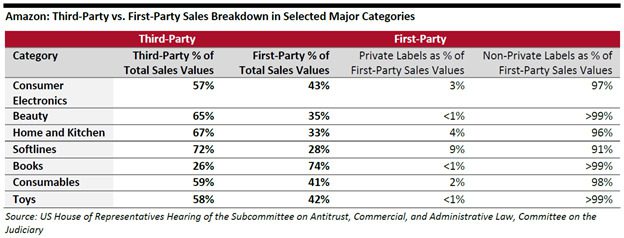
According to Coresight Research’s Inside the World of Amazon’s Private Label Offering report, Amazon now has over 22,617 products from 111 private label brands across nearly every category — three times the number of brands they had in 2018. While Amazon states that private label represents less than 1% of its total sales, when drilling down to specific categories, the picture is much different.

If you’re a consumer brand in a category with Amazon private label, however, Amazon’s private label presence certainly feels more pronounced. Amazon’s aggressive launches and marketing in categories such as batteries, baby food and bedding can create stiff competition for the leading brands in those spaces.

The biggest corporate push has been in fashion, and it’s working: 75% of its private label brands are in fashion, and according to Amazon (see exhibit below), fashion private label sales account for 9% of its total fashion first-party (meaning direct or 1P) sales. The next largest category is home and kitchen, with private label sales representing 4% of first-party sales.


What is Amazon’s Private Label Strategy?

Amazon’s private label strategy isn’t unlike other retailers. Private label is an effective model to drive both sales growth and profit. Products that are exclusive to Amazon drive customer loyalty and traffic to Amazon, thereby improving its sales. In addition, Amazon’s pureplay ecommerce model presents significant profit headwinds.

Private label, especially in profit-challenged categories, gives Amazon an opportunity to design the products for ecommerce success in everything from designing optimal packaging, minimizing shipping weight and addressing feedback in product design.

For example, take Amazon’s Wickedly Prime Chicken Noodle Soup. It addresses many of the design issues that present profit challenges in the traditional canned format. The canned format is not only heavy, which drives up shipping costs, but they also dent easily, driving up customer complaints and replacement costs.


How Did Amazon Launch so Many Brands so Fast?

Amazon has three main types of private label brands and not all of them are Amazon-owned, which has allowed the company to quickly scale its private label program:

  1. Traditional private label model: Brands like Alexa, Amazon Basics and Happy Belly that are fully owned by Amazon and manufactured through a partner brand. Amazon controls the inventory, marketing and promotional strategy.

  2. Amazon’s Manufacturer Accelerator Program: Amazon will, as an incentive, offer a limited amount of free marketing in exchange for the option to buy out the brand at a future date. In this case, the manufacturer is responsible for the inventory planning, marketing and promotional strategy. This program has contributed most significantly to Amazon’s private label brand and SKU counts.

  3. Private label brands through Amazon’s Whole Foods acquisition, such as 365 Everyday Value and Whole Foods brand.


What are the Pros and Cons of Being Amazon’s Private Label Provider?

Amazon’s private label program has two key benefits:

  • Low barrier to entry. Inventory and duration commitments are limited. Manufacturers can get started quickly. Typically, manufacturers will receive their first order within six months, and Amazon provides resources to help with packaging.

  • Access to other platforms. Amazon may be more likely to guarantee access to their other platforms, such as Amazon Go, Prime Now and Amazon Fresh Grocery Stores.

However, there are a few drawbacks to consider as well, relative to traditional brick-and-mortar private label programs:

  • Onus of responsibility. Similar to working on Amazon’s vendor or seller platform, responsibility for promotion, inventory, retailer profit and complying with Amazon’s fulfillment requirements rests on the manufacturer.

  • Volumes are highly uncertain. Amazon will provide inventory forecasts, but they are typically much lower volume than private label programs for traditional brick-and-mortar retailers. In addition, often times the true demand comes in much higher or lower, resulting in chargebacks.

  • Unexpected fees. Each fee is a separate negotiation, and there’s often a fee to “graduate” from the accelerator program.


Help! Amazon Has Launched a Private Label Competitor to my Products. How do I Compete?

If you’re concerned about Amazon’s private label foray into your category, you’re certainly not alone. According to Pattern’s 2019 marketplace survey of ecommerce executives, 73% of executives are “concerned” about competition from Amazon’s private label, and 57% said they were “very concerned”.

However, Amazon launching private label copies of your product actually isn’t the end of the world. There are still ways for brand manufacturers to successfully compete with looming private label brands. Here’s how:

Differentiate. Amazon‘s copy is often a bare-bones lower-priced option. Make it clear what sets your product apart through your product images, title and product detail page. Telling your brand‘s rich story is also a clear point of differentiation vs. Amazon’s corporate private label brands.

Analyze. What is Amazon’s search strategy for the private label brand? Amazon uses algorithms running its paid search (vs. humans), so using Share of Search or a search analytics tool will quickly expose holes in its keyword strategies and help you identify your biggest opportunities.

Innovate. Design for online…or at least, make the best use of the data available to you. Mine your review data and customer feedback for opportunities to improve your products. Amazon does this with most private label launches.

For example, when Amazon launched its top-selling Lark & Ro private label wrap dress, the company took care to address the main complaints about the top-selling branded wrap dress, such as providing extended sizes, a more conservative cut and more color options.

If you see something, say something. Are your Annual Vendor Negotiations (AVN) coming up? This is a great time to mention the added challenge of private label competition and to ensure you’re being treated fairly. If you’re concerned about private label advertising on your product pages, for example, you may be able to negotiate them away. In addition, if private label competition is driving increased advertising costs for you, make sure to communicate with Amazon about the increasing cost to serve their channel.


Key Takeaways

Amazon’s private label program is growing fast. It can be a boon for some vendors who choose or are selected to participate, although weighing the pros and cons is critical. It’s also possible to compete with Amazon’s private label effectively and sustainably.

4 Ways Businesses Can Use Shipping to Reduce Cart Abandonment

(Source: retailtouchpoints.com)  

June 8, 2021 
By Jan Bednar, ShipMonk

Consumers are spending more money online than they do in brick-and-mortar stores, particularly during the busy holiday season. But these same online shoppers do something else that all retailers hate: They fill up carts without making a purchase. Nearly 70% of carts end up abandoned online, and about 85% of mobile shoppers exhibit this behavior.

While it’s easy to rationalize cart abandonment as a standard practice, it is much more than a modern-day version of window shopping. Many factors can contribute to a consumer’s decision to abandon a full shopping cart before checking out.

Asking consumers to create a new account can certainly cause some of this hesitation. Also to blame are overly complex checkout processes, invalid discount codes, security concerns, questionable return policies, comparison shopping, etc. The list goes on, but one other barrier to purchasing seems to be a major sticking point for 63% of consumers: shipping costs.


The True Cost of Shipping

Many retailers overlook the influence shipping costs play in their customers’ tendencies to abandon items in shopping carts, choosing instead to improve other aspects of the customer journey. While navigation and user experience play key roles in this journey, there is clear intent to purchase when a customer fills a shopping cart. By addressing that last hurdle, you can easily achieve:

• Higher Conversion Rates: The internet is a treasure trove of case studies touting free shipping’s sales benefits (though results will vary by retailer). When NuFACE implemented a free-shipping threshold, the skin care company saw orders increase by 90%. Meanwhile, other experts have found conversion rate bumps of approximately 50% by using similar tactics. Your product, purchase behavior and profit margins will determine whether this option will work for your business.

• Lower Abandonment Rates: Cart abandonment is a much bigger problem than you might think — it leads to an estimated $4.6 trillion in lost sales annually. A better checkout process can often correct issues and increase conversion rates by 35%. Of the countless ways you can optimize checkout, one of your main priorities should be addressing shipping and handling costs.

• More Repeat Business: The happier the customer, the more likely they’ll return for another purchase. One study found that 42% of consumers will make additional purchases after a positive experience with a business, and many will become loyal customers. Addressing the costs associated with shipping and handling is often one of the easiest ways to improve the overall customer experience.

By far one of the biggest misconceptions for many retailers revolves around free shipping. Newcomers to the ecommerce space often see free shipping as unattainable. In reality, the businesses that can benefit most from this service offering are small and midsized retailers looking to scale their companies, widen their reach and build customer loyalty.

Making Purchases Not as Costly

There is no single reason why consumers choose to abandon their shopping carts. A lot of variables are at play within the online shopping experience. Considering the cost of goods will always be a concern, so why not remove or reduce that barrier by rethinking your shipping and handling approach? Here are a few great places to start:


1. Negotiate shipping rates.

Negotiating shipping rates might not sound like the shrewdest tactic to remedy cart abandonment issues. But higher-than-expected shipping costs top even price comparison as the primary motivator for cart abandonment. It’s never a bad time to begin your own price comparisons on shipping rates.

Even small businesses should be shopping around. Though their negotiating power may not be as strong as Amazon, Walmart and other major retailers, they still have some leverage. It all comes down to two factors: Competitive landscape and shipping volume. In short, never take the prices listed on a carrier’s website as gospel.

Besides, your business has probably been solicited by other carriers already. Get on the horn with the U.S. Postal Service, UPS, FedEx and DHL for more information on current rates, but be sure to let your primary carrier know about your possible migration to a competitor. The sales rep might offer a lower rate to maintain your business.


2. Reduce shipping rates for minimum orders.

You may not know this, but Walmart doesn’t offer free shipping unless customers meet a certain price threshold — or with a membership to its Walmart+ program; Target takes a similar tack. If this approach works for two of the country’s largest retailers, then it should work well for you and your business.

Experiment with minimum order values to arrive at the ideal price for customers. Because you’ll be absorbing shipping costs, review your margins to ensure free shipping doesn’t eat too much into your revenue. You may find that reduced shipping rates are a better option, and the same could be said for free shipping on certain products.


3. Offer periodic shipping deals.

Even with a minimum order, free shipping isn’t always sustainable for small businesses throughout the year. Other shipping promotions can be just as tempting to consumers. Free shipping to first-time buyers, for example, is a promotion many retailers use as an alternative to offering a discount on first orders.

If you’re looking to add to your email list, you can offer a promo code for free shipping in exchange for an email address. You might also consider offering free shipping at certain times of the year. Much like reduced or free shipping with a minimum order, play around with various offers to find something that resonates with shoppers.


4. Outsource to a third-party logistics provider.

Brick-and-mortar retailers generally use a business model where customers leave the store with their purchases — no packing or delivering required. As they move into the ecommerce space, however, that changes in a hurry. Suddenly, they face the complicated and unfamiliar task of order fulfillment.

Enter the third-party logistic provider (or 3PL, for short). Outsourcing fulfillment allows you to bypass the entire shipping process. Packing boxes, tracking orders and even warehousing goods are now in the hands of experts, enabling you to instead focus on your core competencies. More importantly, 3PLs bring a negotiating power that can lock in pricing for their customers and help you reduce shipping costs.

Suppose your business is shipping to new areas, subject to seasonal spikes or simply lacking the workforce to handle fulfillment. In that case, 3PLs can provide stability and flexibility with delivery while keeping your overall shipping costs down.

Businesses are always looking for new ways to make customers happy. On some level, a focus on shipping and handling just doesn’t seem as sexy as investing in user experience and site navigation. A site that’s visually appealing and easy to navigate can do wonders for getting consumers to fill their carts, after all.

But once they’re ready to check out, the sticker shock of shipping can lead shoppers to rethink their decision and leave behind full carts in the process. Take the time to explore your options with shipping and handling — it could make all the difference in your sales results.

The most recent dish... enjoy!

How the IRS is trying to nail crypto tax dodgers

(Source: cnbc.com )  PUBLISHED WED, JUL 14 2021, 12:08 PM EDT; UPDATED THU, JUL 15 2021 2:00 PM EDT MacKenzie Sigalos  @KENZIESIGALOS KEY PO...

Popular Dishes