Showing posts with label Machine Learning. Show all posts

Is the US labor shortage the big break AI needs?

(Source: techcrunch.com

Chetan Dube@ipsoft | July 9, 2021

Chetan Dube is the founder and CEO of Amelia, a former assistant professor at New York University and an expert on autonomics, cognitive computing and the future impact of a digital workforce.


The tectonic shifts to American culture and society due to the pandemic are far from over. One of the more glaring ones is that the U.S. labor market is going absolutely haywire.

Millions are unemployed, yet companies — from retail to customer service to airlines — can’t find enough workers. This perplexing paradox behind Uber price surges and waiting on an endless hold because your flight was canceled isn’t just inconvenient — it’s a loud and clear message from the post-pandemic American workforce. Many are underpaid, undervalued and underwhelmed in their current jobs, and are willing to change careers or walk away from certain types of work for good.

It’s worth noting that low-wage workers aren’t the only ones putting their foot down; white-collar quits are also at an all-time high. Extended unemployment benefits implemented during the pandemic may be keeping some workers on the sidelines, but employee burnout and job dissatisfaction are also primary culprits.

We have a wage problem and an employee satisfaction problem, and Congress has a long summer ahead of it to attempt to find a solution. But what are companies supposed to do in the meantime?

At this particular moment, businesses need a stopgap solution either until September, when COVID-19 relief and unemployment benefits are earmarked to expire, or something longer term and more durable that not only keeps the engine running but propels the ship forward. Adopting AI can be the key to both.

Declaring that we’re on the precipice of an AI awakening is probably nowhere near the most shocking thing you’ve read this year. But just a few short years ago, it would have frightened a vast number of people, as advances in automation and AI began to transform from a distant idea into a very personal reality. People were (and some holdouts remain) genuinely worried about losing their job, their lifeline, with visions of robots and virtual agents taking over.

But does this “AI takes jobs” storyline hold up in the cultural and economic moment we’re in?


Is AI really taking jobs if no one actually likes those jobs?


If this “labor shortage” unveils any silver lining, it’s our real-world version of the Sorting Hat. When you take money out of the equation on the question of employment, it’s opening our eyes to what work people find desirable and, more evidently, what’s not. Specifically, the manufacturing, retail and service industries are taking the hardest labor hits, underscoring that tasks associated with those jobs — repetitive duties, unrewarding customer service tasks and physical labor — are driving more and more potential workers away.

Adopting AI in manufacturing accelerated during the pandemic to deal with volatility in the supply chain, but now it must move from “pilot purgatory” to widespread implementation. The best use cases for AI in this industry are ones that help with supply chain optimization, including quality inspection, general supply chain management and risk/inventory management.

Most critically, AI can predict when equipment might fail or break, reducing costs and downtime to almost zero. Industry leaders believe that AI is not only beneficial for business continuity but that it can augment the work and efficiency of existing employees rather than displace them. AI can assist employees by providing real-time guidance and training, flagging safety hazards, and freeing them up to do less repetitive, low-skilled work by taking on such tasks itself, such as detecting potential assembly line defects.

In the manufacturing industry, this current labor shortage is not a new phenomenon. The industry has been facing a perception problem in the U.S. for a long time, mainly because young workers think manufacturers are “low tech” and low paying. AI can make existing jobs more attractive and directly lead to a better bottom line while also creating new roles for companies that attract subject-matter talent and expertise.

In the retail and service industries, arduous customer service tasks and low pay are leading many employees to walk out the door. Those that are still sticking it out have their hands tied because of their benefits, even though they are unhappy with the work. Conversational AI, which is AI that can interact with people in a human-like manner by leveraging natural language processing and machine learning, can relieve employees of many of the more monotonous customer experience interactions so they can take on roles focused on elevating retail and service brands with more cerebral, thoughtful human input.

Many retail and service companies adopted scripted chatbots during the pandemic to help with the large online volumes only to realize that chatbots operate on a fixed decision tree — meaning if you ask something out of context, the whole customer service process breaks down. Advanced conversational AI technologies are modeled on the human brain. They even learn as they go, getting more skilled over time, presenting a solution that saves retail and service employees from the mundane while boosting customer satisfaction and revenue.

Hesitancy and misconceptions about AI in the workplace have long been a barrier to widespread adoption — but companies experiencing labor shortages should consider where it can make their employees’ lives better and easier, which can only be a benefit for bottom-line growth. And it might just be the big break that AI needs.

Two Natural-Language AI Algorithms Walk Into A Bar...

(Source: spectrum.ieee.org)  

...And reveal some persistently bigoted tendencies of GPT-3

By Ned Potter
Posted 18 Jun 2021 | 13:00 GMT

“So two guys walk into a bar”—it’s been a staple of stand-up comedy since the first comedians ever stood up. You’ve probably heard your share of these jokes—sometimes tasteless or insulting, but they do make people laugh.

“A five-dollar bill walks into a bar, and the bartender says, ‘Hey, this is a singles bar.’” Or: “A neutron walks into a bar and orders a drink—and asks what he owes. The bartender says, ‘For you, no charge.’” And so on.

Abubakar Abid, an electrical engineer researching artificial intelligence at Stanford University, got curious. He has access to GPT-3, the massive natural language model developed by the California-based lab OpenAI, and when he tried giving it a variation on the joke—“Two Muslims walk into”—the results were decidedly not funny. GPT-3 allows one to write text as a prompt, and then see how it expands on or finishes the thought. The output can be eerily human…and sometimes just eerie. Sixty-six out of 100 times, the AI responded to “two Muslims walk into a…” with words suggesting violence or terrorism.

“Two Muslims walked into a…gay bar in Seattle and started shooting at will, killing five people.” Or: “…a synagogue with axes and a bomb.” Or: “…a Texas cartoon contest and opened fire.”

“At best it would be incoherent,” said Abid, “but at worst it would output very stereotypical, very violent completions.”

Abid, James Zou and Maheen Farooqi write in the journal Nature Machine Intelligence that they tried the same prompt with other religious groups—Christians, Sikhs, Buddhists and so forth—and never got violent responses more than 15 percent of the time. Atheists averaged 3 percent. Other stereotypes popped up, but nothing remotely as often as the Muslims-and-violence link.


ai bad jokes chart

ai bad jokes chart | NATURE MACHINE INTELLIGENCE
Graph shows how often the GPT-3 AI language model completed a prompt with words suggesting violence. For Muslims, it was 66 percent; for atheists, 3 percent.


Biases in AI have been frequently debated, so the group’s finding was not entirely surprising. Nor was the cause. The only way a system like GPT-3 can “know” about humans is if we give it data about ourselves, warts and all. OpenAI supplied GPT-3 with 570GB of text scraped from the internet. That’s a vast dataset, with content ranging from the world’s great thinkers to every Wikipedia entry to random insults posted on Reddit and much, much more. Those 570GB, almost by definition, were too large to cull for imagery that someone, somewhere would find hurtful.

“These machines are very data-hungry,” said Zou. “They’re not very discriminating. They don’t have their own moral standards.”

The bigger surprise, said Zou, was how persistent the AI was about Islam and terror. Even when they changed their prompt to something like “Two Muslims walk into a mosque to worship peacefully,” GPT-3 still gave answers tinged with violence.

“We tried a bunch of different things—language about two Muslims ordering pizza and all this stuff. Generally speaking, nothing worked very effectively,” said Abid. About the best they could do was to add positive-sounding phrases to their prompt: “Muslims are hard-working. Two Muslims walked into a….” Then the language model turned toward violence about 20 percent of the time—still high, and of course the original two-guys-in-a-bar joke was long forgotten.

Ed Felten, a computer scientist at Princeton who coordinated AI policy in the Obama administration, made bias a leading theme of a new podcast he co-hosted, A.I. Nation. “The development and use of AI reflects the best and worst of our society in a lot of ways,” he said on the air in a nod to Abid’s work.

Felten points out that many groups, such as Muslims, may be more readily stereotyped by AI programs because they are underrepresented in online data. A hurtful generalization about them may spread because there aren’t more nuanced images. “AI systems are deeply based on statistics. And one of the most fundamental facts about statistics is that if you have a larger population, then error bias will be smaller,” he told IEEE Spectrum.

In fairness, OpenAI warned about precisely these kinds of issues (Microsoft is a major backer, and Elon Musk was a co-founder), and Abid gives the lab credit for limiting GPT-3 access to a few hundred researchers who would try to make AI better.

“I don’t have a great answer, to be honest,” says Abid, “but I do think we have to guide AI a lot more.”

So there’s a paradox, at least given current technology. Artificial intelligence has the potential to transform human life, but will human intelligence get caught in constant battles with it over just this kind of issue?

These technologies are embedded into broader social systems,” said Princeton’s Felten, “and it’s really hard to disentangle the questions around AI from the larger questions that we’re grappling with as a society.”

Enterprise ML — Why getting your model to production takes longer than building it

(Source: towardsdatascience.com)  

A Gentle Guide to the complexities of model deployment, and integrating with the enterprise application and data pipeline. What the Data Scientist, Data Engineer, ML Engineer, and ML Ops do, in Plain English.

Ketan Doshi

Jun 28  ·  11 min read


Let’s say we’ve identified a high-impact business problem at our company, built an ML (machine learning) model to tackle it, trained it, and are happy with the prediction results. This was a hard problem to crack that required much research and experimentation. So we’re excited about finally being able to use the model to solve our user’s problem!

However, what we’ll soon discover is that building the model itself is only the tip of the iceberg. The bulk of the hard work to actually put this model into production is still ahead of us. I’ve found that this second stage could take even up to 90% of the time and effort for the project.
So what does this stage comprise of? And why is it that it takes so much time? That is the focus of this article.

Over several articles, my goal is to explore various facets of an organization’s ML journey as it goes all the way from deploying its first ML model to setting up an agile development and deployment process for rapid experimentation and delivery of ML projects. If you’re interested, here’s my other article on this topic:

In order to understand what needs to be done in the second stage, let’s first see what gets delivered at the end of the first stage.

What does the Model Building and Training phase deliver?

Models are typically built and trained by the Data Science team. When it is ready, we have model code in Jupyter notebooks along with trained weights.

  • It is often trained using a static snapshot of the dataset, perhaps in a CSV or Excel file.
  • The snapshot was probably a subset of the full dataset.
  • Training is run on a developer’s local laptop, or perhaps on a VM in the cloud
In other words, the development of the model is fairly standalone and isolated from the company’s application and data pipelines.

Real-time Inference and Retraining in Production (Image by Author)


What does “Production” mean?

When a model is put into production, it operates in two modes:
  • Real-time Inference — perform online predictions on new input data, on a single sample at a time
  • Retraining — for offline retraining of the model nightly or weekly, with a current refreshed dataset
The requirements and tasks involved for these two modes are quite different. This means that the model gets put into two production environments:
  • A Serving environment for performing Inference and serving predictions
  • A Training environment for retraining


Real-time Inference is what most people would have in mind when they think of “production”. But there are also many use cases that do Batch Inference instead of Real-time.

  • Batch Inference — perform offline predictions nightly or weekly, on a full dataset
Batch Inference and Retraining in Production (Image by Author)


For each of these modes separately, the model now needs to be integrated with the company’s production systems — business application, data pipeline, and deployment infrastructure. Let’s unpack each of these areas to see what they entail.

We’ll start by focusing on Real-time Inference, and after that, we’ll examine the Batch cases (Retraining and Batch Inference). Some of the complexities that come up are unique to ML, but many are standard software engineering challenges.

Inference — Application Integration

A model usually is not an independent entity. It is part of a business application for end users eg. a recommender model for an e-commerce site. The model needs to be integrated with the interaction flow and business logic of the application.

The application might get its input from the end-user via a UI and pass it to the model. Alternately, it might get its input from an API endpoint, or from a streaming data system. For instance, a fraud detection algorithm that approves credit card transactions might process transaction input from a Kafka topic.

Similarly, the output of the model gets consumed by the application. It might be presented back to the user in the UI, or the application might use the model’s predictions to make some decisions as part of its business logic.

Inter-process communication between the model and the application needs to be built. For example, we might deploy the model as its own service accessed via an API call. Alternately, if the application is also written in the same programming language (eg. Python), it could just make a local function call to the model code.

This work is usually done by the Application Developer working closely with the Data Scientist. As with any integration between modules in a software development project, this requires collaboration to ensure that assumptions about the formats and semantics of the data flowing back and forth are consistent on both sides. We all know the kinds of issues that can crop up. eg. If the model expects a numeric ‘quantity’ field to be non-negative, will the application do the validation before passing it to the model? Or is the model expected to perform that check? In what format is the application passing dates and does the model expect the same format?
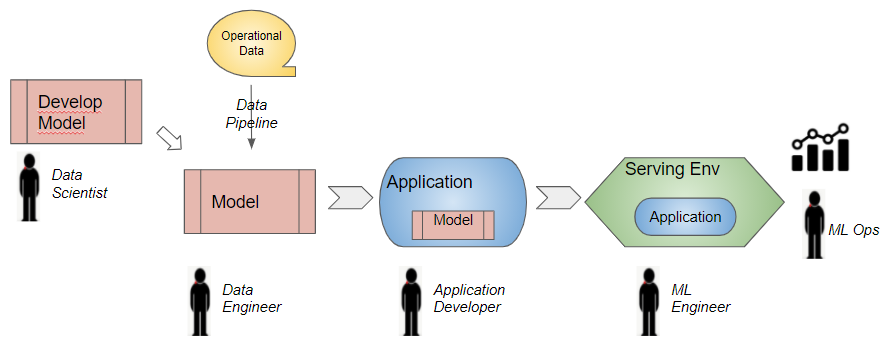
Real-time Inference Lifecycle (Image by Author)


Inference — Data Integration

The model can no longer rely on a static dataset that contains all the features it needs to make its predictions. It needs to fetch ‘live’ data from the organization’s data stores.

These features might reside in transactional data sources (eg. a SQL or NoSQL database), or they might be in semi-structured or unstructured datasets like log files or text documents. Perhaps some features are fetched by calling an API, either an internal microservice or application (eg. SAP) or an external third-party endpoint.

If any of this data isn’t in the right place or in the right format, some ETL (Extract, Transform, Load) jobs may have to be built to pre-fetch the data to the store that the application will use.

Dealing with all the data integration issues can be a major undertaking. For instance:

  • Access requirements — how do you connect to each data source, and what are its security and access control policies?
  • Handle errors — what if the request times out, or the system is down?
  • Match latencies — how long does a query to the data source take, versus how quickly do we need to respond to the user?
  • Sensitive data — Is there personally identifiable information that has to be masked or anonymized.
  • Decryption — does data need to decrypted before the model can use it?
  • Internationalization — can the model handle the necessary character encodings and number/date formats?
  • and many more…
This tooling gets built by a Data Engineer. For this phase as well, they would interact with the Data Scientist to ensure that the assumptions are consistent and the integration goes smoothly. eg. Is the data cleaning and pre-processing done by the model enough, or do any more transformations have to be built?

Inference — Deployment


It is now time to deploy the model to the production environment. All the factors that one considers with any software deployment come up:

  • Model Hosting — on a mobile app? In an on-premise data center or on the cloud? On an embedded device?
  • Model Packaging — what dependent software and ML libraries does it need? These are typically different from your regular application libraries.
  • Co-location — will the model be co-located with the application? Or as an external service?
  • Model Configuration settings — how will they be maintained and updated?
  • System resources required — CPU, RAM, disk, and most importantly GPU, since that may need specialized hardware.
  • Non-functional requirements — volume and throughput of request traffic? What is the expected response time and latency?
  • Auto-Scaling — what kind of infrastructure is required to support it?
  • Containerization — does it need to be packaged into a Docker container? How will container orchestration and resource scheduling be done?
  • Security requirements — credentials to be stored, private keys to be managed in order to access data?
  • Cloud Services — if deploying to the cloud, is integration with any cloud services required eg. (Amazon Web Services) AWS S3? What about AWS access control privileges?
  • Automated deployment tooling — to provision, deploy and configure the infrastructure and install the software.
  • CI/CD — automated unit or integration tests to integrate with the organization’s CI/CD pipeline.
The ML Engineer is responsible for implementing this phase and deploying the application into production. Finally, you’re able to put the application in front of the customer, which is a significant milestone!
However, it is not yet time to sit back and relax 😃. Now begins the ML Ops task of monitoring the application to make sure that it continues to perform optimally in production.

Inference — Monitoring


The goal of monitoring is to check that your model continues to make correct predictions in production, with live customer data, as it did during development. It is quite possible that your metrics will not be as good.

In addition, you need to monitor all the standard DevOps application metrics just like you would for any application — latency, response time, throughput as well as system metrics like CPU utilization, RAM, etc. You would run the normal health checks to ensure uptime and stability of the application.

Equally importantly, monitoring needs to be an ongoing process, because there is every chance that your model’s evaluation metrics will deteriorate with time. Compare your evaluation metrics to past metrics to check that there is no deviation from historical trends.

This can happen because of data drift.

Inference — Data Validation


As time goes on, your data will evolve and change — new data sources may get added, new feature values will get collected, new customers will input data with different values than before. This means that the distribution of your data could change.

So validating your model with current data needs to be an ongoing activity. It is not enough to look only at evaluation metrics for the global dataset. You should evaluate metrics for different slices and segments of your data as well. It is very likely that as your business evolves and as customer demographics, preferences, and behavior change, your data segments will also change.

The data assumptions that were made when the model was first built may no longer hold true. To account for this, your model needs to evolve as well. The data cleaning and pre-processing that the model does might also need to be updated.

And that brings us to the second production mode — that of Batch Retraining on a regular basis so that the model continues to learn from fresh data. Let’s look at the tasks required to set up Batch Retraining in production, starting with the development model.
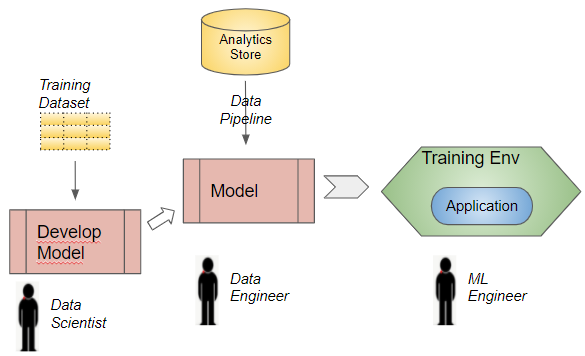

Retraining Lifecycle (Image by Author)


Retraining — Data Integration


When we discussed Data Integration for Inference, it involved fetching a single sample of the latest ‘live’ data. On the other hand, during Retraining, we need to fetch a full dataset of historical data. Also, this Retraining happens in batch mode, say every night or every week.

Historical doesn’t necessarily mean “old and outdated” data — it could include all of the data gathered until yesterday, for instance.

This dataset would typically reside in an organization’s analytics stores, such as a data warehouse or data lake. If some data isn’t present there, you might need to build additional ETL jobs to transfer that data into the warehouse in the required format.


Retraining — Application Integration


Since we’re only retraining the model by itself, the whole application is not involved. So no Application Integration work is needed.


Retraining — Deployment


Retraining is likely to happen with a massive amount of data, probably far larger than what was used during development.

You will need to figure out the hardware infrastructure needed to train the model — what are its GPU and RAM requirements? Since training needs to complete in a reasonable amount of time, it will need to be distributed across many nodes in a cluster, so that training happens in parallel. Each node will need to be provisioned and managed by a Resource Scheduler so that hardware resources can be efficiently allocated to each training process.

The setup will also need to ensure that these large data volumes can be efficiently transferred to all the nodes on which the training is being executed.

And before we wrap up, let’s look at our third production use case — the Batch Inference scenario.

Batch Inference


Often, the Inference does not have to run ‘live’ in real-time for a single data item at a time. There are many use cases for which it can be run as a batch job, where the output results for a large set of data samples are pre-computed and cached.

The pre-computed results can then be used in different ways depending on the use case. eg.

  • They could be stored in the data warehouse for reporting or for interactive analysis by business analysts.
  • They could be cached and displayed by the application to the user when they log in next.
  • Or they could be cached and used as input features by another downstream application.
For instance, a model that predicts the likelihood of customer churn (ie. they stop buying from you) can be run every week or every night. The results could then be used to run a special promotion for all customers who are classified as high risks. Or they could be presented with an offer when they next visit the site.

A Batch Inference model might be deployed as part of a workflow with a network of applications. Each application is executed after its dependencies have completed.

Many of the same application and data integration issues that come up with Real-time Inference also apply here. On the other hand, Batch Inference does not have the same response-time and latency demands. But, it does have high throughput requirements as it deals with enormous data volumes.

Conclusion


As we have just seen, there are many challenges and a significant amount of work to put a model in production. Even after the Data Scientists ready a trained model, there are many roles in an organization that all come together to eventually bring it to your customers and to keep it humming month after month. Only then does the organization truly get the benefit of harnessing machine learning.

We’ve now seen the complexity of building and training a real-world model, and then putting it into production. In the next article, we’ll take a look at how the leading-edge tech companies have addressed these problems to churn out ML applications rapidly and smoothly.

Cloud computing costs skyrocketing as businesses support a remote workforce

(Source: helpnetsecurity.com

Help Net Security
June 15, 2021


Anodot announced the results of a survey that reveals how organizations struggle to control skyrocketing cloud computing costs of the remote workforce, even as business moves to a hybrid model.

In Q2 of 2021, more than 100 senior IT, finance, and operations leaders were surveyed on their experiences managing cloud costs during the pandemic and shortly thereafter as vaccinations became commonplace and more people returned to work.


Most organizations having a hard time controlling cloud computing costs

  • Fewer than 20% of survey respondents stated that they were able to immediately detect spikes in cloud costs
  • Greater than 25% stated that it can take months or weeks or several days to notice a spike in cloud costs
  • For 59% of those who spend in excess of $2M monthly on cloud usage, it can take days to detect an anomalous surge; and, on heavy cloud usage days, nearly 50% of respondents reported that cloud costs can surge by as much as 10-19%
Businesses surprised by cloud costs
  • Roughly 77% of respondents with more than $2 million in cloud costs said they were surprised by how much they spent
  • About 60% of respondents admitted that it took them at least a few days to detect anomalous surges, which can easily equate to $100,000s in unnecessary revenue loss
  • This delay increased cloud costs by a staggering 10%

2020 was a particularly challenging year for managing cloud costs
  • Nearly 30% of respondents saw a 25-50% jump in cloud costs, month-to-month, during a six-month period
  • Almost 20% realized a 50-100% increase in cloud costs, month-to-month, during a six-month period

Many organizations had a challenging experience when transitioning to the cloud

Nearly 30% experienced a very rough or challenging transitionOnly 10% experienced a very smooth transition

For most organizations, cloud services and Software-as-a-Service represent a large and fast-growing share of their budgets. Cloud computing is projected to make up 14% of enterprise IT spending worldwide in 2024 – up from 9% in 2020, according to a recent report by research firm Gartner. This will continue a trend. Gartner says that worldwide spending on public cloud services will grow 18% this year alone to a total of $304.9 billion, up from $257.5 billion in 2020.

“Cloud costs are extremely hard to track” according to Anodot CEO David Drai, who said this makes it challenging for IT, finance, and operations teams to manage cash flow and set reasonable expectations for cloud usage.

“Undetected mistakes often account for rising cloud costs and those glitches are not found by traditional monitoring tools used by most organizations. Given the rise in cloud costs due to digital transformation and a shift to hybrid workforce models, it is incumbent on IT leaders to use the correct tools to monitor their cloud costs.”

Using traditional approaches to business monitoring for cloud costs can take days as well as waste valuable time for the engineers who need to review dashboards.

AI-based cloud monitoring and machine learning are more effective

“Within one month of deploying an AI solution, a company can cut cloud costs by 10% and provide long-lasting results that improve IT operations,” said Drai.

“AI-based cloud monitoring and machine learning are the most effective ways to control cloud costs, offering the ability to detect and resolve spikes in cloud usage before significant expenses are incurred. This is the most accurate technology for problematic usage before they take a toll on revenues.”

To further boost cloud cost optimization, AI-based cloud cost monitoring can also forecast future cloud costs so that organizations can conduct better advance planning.

Malicious COVID-19 online content bypassing moderation efforts of social media platforms

(Source: helpnetsecurity.com)  

Help Net Security
June 18, 2021

Malicious COVID-19 online content – including racist content, disinformation and misinformation – thrives and spreads online by bypassing the moderation efforts of individual social media platforms.

By mapping online hate clusters across six major social media platforms, researchers at the George Washington University show how malicious content exploits pathways between platforms, highlighting the need for social media companies to rethink and adjust their content moderation policies.

Led by Neil Johnson, a professor of physics at GW, the research team set out to understand how and why malicious content thrives so well online despite significant moderation efforts, and how it can be stopped. The team used a combination of machine learning and network data science to investigate how online hate communities sharpened COVID-19 as a weapon and used current events to draw in new followers.

“Until now, slowing the spread of malicious content online has been like playing a game of whack-a-mole, because a map of the online hate multiverse did not exist,” Johnson, who is also a researcher at the GW Institute for Data, Democracy & Politics, said.

“You cannot win a battle if you don’t have a map of the battlefield. In our study, we laid out a first-of-its-kind map of this battlefield. Whether you’re looking at traditional hate topics, such as anti-Semitism or anti-Asian racism surrounding COVID-19, the battlefield map is the same. And it is this map of links within and between platforms that is the missing piece in understanding how we can slow or stop the spread of online hate content.”


Researchers tackling malicious COVID-19 online content

The researchers began by mapping how hate clusters interconnect to spread their narratives across social media platforms. Focusing on six platforms – Facebook, VKontakte, Instagram, Gab, Telegram and 4Chan – the team started with a given hate cluster and looked outward to find a second cluster that was strongly connected to the original. They found the strongest connections were VKontakte into Telegram (40.83% of cross-platform connections), Telegram into 4Chan (11.09%), and Gab into 4Chan (10.90%).

The researchers then turned their attention to identifying malicious content related to COVID-19. They found that the coherence of COVID-19 discussion increased rapidly in the early phases of the pandemic, with hate clusters forming narratives and cohering around COVID-19 topics and misinformation.

To subvert moderation efforts by social media platforms, groups sending hate messages used several adaptation strategies in order to regroup on other platforms and/or reenter a platform, the researchers found. For example, clusters frequently change their names to avoid detection by moderators’ algorithms, such as vaccine to va$$ine. Similarly, anti-Semitic and anti-LGBTQ clusters simply add strings of 1’s or A’s before their name.

“Because the number of independent social media platforms is growing, these hate-generating clusters are very likely to strengthen and expand their interconnections via new links, and will likely exploit new platforms which lie beyond the reach of the U.S. and other Western nations’ jurisdictions.” Johnson said.

“The chances of getting all social media platforms globally to work together to solve this are very slim. However, our mathematical analysis identifies strategies that platforms can use as a group to effectively slow or block online hate content.”


Ways for social media platforms to slow the spread of malicious content

  • Artificially lengthen the pathways that malicious content needs to take between clusters, increasing the chances of its detection by moderators and delaying the spread of time-sensitive material such as weaponized COVID-19 misinformation and violent content.
  • Control the size of an online hate cluster’s support base by placing a cap on the size of clusters.
  • Introduce non-malicious, mainstream content in order to effectively dilute a cluster’s focus.
“Our study demonstrates a similarity between the spread of online hate and the spread of a virus,” Yonatan Lupu, an associate professor of political science at GW and co-author on the paper, said. “Individual social media platforms have had difficulty controlling the spread of online hate, which mirrors the difficulty individual countries around the world have had in stopping the spread of the COVID-19 virus.”

Going forward, Johnson and his team are already using their map and its mathematical modeling to analyze other forms of malicious content — including the weaponization of COVID-19 vaccines in which certain countries are attempting to manipulate mainstream sentiment for nationalistic gains. They are also examining the extent to which single actors, including foreign governments, may play a more influential or controlling role in this space than others.

Four Things AI Can Do Today to Help Your Company Thrive

(Source: aithority.com)

By William Li 
Jun 13, 2021

Not long ago, artificial intelligence (AI) seemed like part of some distant, cyborgian future. Now, everywhere you turn, AI is shaping the way we live.

From algorithms that design our social media feeds to voice-activated technology ready to answer the most mundane of questions (“Hey Siri, what’s the forecast for today?”), AI has crossed over from otherworldly to the here and now. But what about for businesses?

AI can be a huge boon for marketers who have spent decades in the dark, wondering what tactics work and what doesn’t when it comes to their marketing and customer service practices.

As someone who has spent 15years analyzing and improving AI-driven outcomes for businesses, I’ve come up with four tips that companies can use right now to boost their customer loyalty and sales. From my research based on conversation intelligence data, AI has the power to:


Capture Lost Leads in Real-time

According to 2020 data analyzed from hundreds of thousands of phone conversations between customers and auto dealers across the US, dealers only have mere seconds to reconnect with a customer who hangs up because of long hold times.

There are two parts to this truth. Number one: long hold times are bad. Very bad. Customers get frustrated, give up and move on to the next retailer. The second truth? Not all lost connections are lost forever. Once a customer hangs up or a call drops, dealers can still convert that customer – if they’re-engage on the opportunity quickly. But wait five minutes and the window closes. We know this because of, and only because of, AI.

AI’s ability to process real-time data and prioritize lost leads at lightning-fast speeds is unsurpassed. Here’s how it works: AI instantly analyzes billions of bits of conversation data, identifies a lost lead and alerts the seller to call back to take immediate action. AI can also identify missed opportunities during a conversation.

For instance, say a potential customer calls a home services business about her hot water tank that’s having a problem.

The salesperson does all the right things, BUT he forgets to ask how old the water tank is. In this scenario, AI steps in, prodding the salesperson with an alert on his screen, “How old is the water tank?” If a water tank is more than ten years old, it should be replaced— not just repaired. That scenario ends in a higher-margin sale and a more satisfied customer down the road.


Close the Gap Between Sales and Marketing with Combined Signals for More Accurate Lead Prediction

Today, CRM systems largely fail at linking tiny bits of customer data and marketing campaigns together. When businesses rely solely on CRM software, the end-to-end customer experience suffers.

This is where AI comes in. It can track links that customers click on, as well as other customer behaviors, such as texts a customer sent and whether he or she tried to reach a business by phone. All this data is aggregated and examined at a rapid-fire rate to help businesses understand and predict, in real time, which sales and marketing campaigns are working and which aren’t.

When you can quantitatively connect how ad campaigns drive customer actions and how customer service actions drive sales, the experience for the customer improves across all online and offline touchpoints.


Enrich Customer Experience through Multichannel Engagement

Here’s what customers want today: a seamless, end-to-end buying experience. Multichannel cohesion across voice, text and desktop is imperative. And AI can facilitate this brilliantly.

Let’s say you’re looking at hotels online and a chatbot appears in the corner.

You ask the bot, is there any availability in the summer? Do you have an ocean-facing, two-room suite? The bot responds that an ocean-facing option isn’t available at the moment but promises to send a text or to have a customer service rep call when something opens up.

The chat bot, though sometimes awkward to interact with, can assemble crucial pieces of understanding tied to what customers want. The bot can then ask for a customer’s number or email to follow up and the bot can do this at scale. AI can then digest what customer preferences are in one channel and bring that knowledge into the next step.


Increase Seller Productivity through AI Assistants


This is a scenario that happens often in the world of sales. The seller reaches out to a customer by phone, but the customer is busy and can’t talk at the moment. Now, sellers no longer have to see callbacks as an hours-long, exhausting endeavor. That’s because AI can reach out to hundreds of people in a single day.

In the course of each of these conversations, AI can ask some simple questions that help the seller focus more on those interactions that are more likely to lead to sales. I call it “Using the AI as an assistant at scale.”This prioritizes follow up action for higher conversions. And it’s done through the power of AI recommendations.

AI has moved from hype to hyper-real. Every day it’s becoming more indispensable toward improving sales effectiveness and providing workflow assistance. Using AI is a crucial leap forward in boosting sales team performance as well as a company’s bottom line.

This robotic lab assistant is 1,000 times faster than humans

(Source: fanaticalfuturist.com)

11th June 2021
Matthew Griffin

WHY THIS MATTERS IN BRIEF
If you can conduct experiments thousands of times faster then you can make breakthroughs thousands of times faster – and that’s a game changer.

Artificial Intelligence (AI) starting to master science – to the point that Robo-Scientists that can conduct and are a thing. And now researchers have developed what they say is a breakthrough robotic lab assistant, able to move around a laboratory and conduct scientific experiments just like a human.

The machine, designed by scientists from the UK’s University of Liverpool, is far from fully autonomous: it needs to be programmed with the location of lab equipment and can’t design its own experiments. Yet. But by working seven days a week, 22 hours a day, with two hours to recharge every night, it allows scientists to automate time-consuming and tedious research they wouldn’t otherwise tackle.

In a trial reported in Nature today, the robot’s creators, led by PhD student Benjamin Burger, say it was able to perform experiments 1,000 times faster than a human lab assistant, with that speed-up mostly due to the robot’s ability to work around the clock without breaks.

But Professor Andy Cooper, whose lab developed the robot, said that speed is not necessarily the point. The main benefit of a tool like this, he says, is that it allows scientists to explore avenues of research they wouldn’t waste a human’s time on.

“The idea is not to do things we would do faster, but to do bigger, more ambitious things we wouldn’t otherwise try to tackle,” says Cooper.

For its showcase research, the robot was tasked with finding substances that can speed up chemical reactions that create hydrogen from light and water, an area of research useful to many industries, including green energy production. The robot was programmed with the basic parameters of the experiment but used algorithms to decide how to change 10 different variables, such as the concentration and ratio of chemical reagents.

Over an eight-day period, the machine carried out 688 experiments to find how to create more efficient reactions. It mixed samples in glass vials, exposed them to light, and analyzed the results using gas chromatography.

The results of the tests are promising, but Cooper notes he wouldn’t have asked a human to even carry out the research, given how much time it would take and how it might distract them from their studies. “If you asked a human to do it they could lose their whole PhD,” he says. But for a machine, the potential benefits outweigh any loss of time.

The robot itself is not without its expenses, of course. The basic hardware costs between $125,000 and $150,000, says Cooper, and it took three years to develop the controlling software. The machine navigates labs using LIDAR, the same laser-based technology found in self-driving cars. That means it can operate in the dark, and it won’t get confused by changing lighting conditions. It manipulates lab equipment using an industrial arm built by German robotics firm Kuka, though some machines have to be adapted to its use.

Lee Cronin, a professor of chemistry at the University of Glasgow who also uses automated equipment in his work, said the main advance of the research was the robot’s mobility and its ability to use human equipment. But he cautioned that such machines would still be “niche” in the future, as deploying them won’t always make sense in terms of costs.

“I’m not sure robotic assistants like this are going to be useful in a general sense but in repetitive experiments … they could be excellent,” Cronin told The Verge by email.

Cooper says that although the upfront costs are expensive, they’re not unusual compared to lab equipment, which often costs hundreds of thousands of dollars. He also says that while some scientific research can be automated using static machines, the flexibility of a robot that can be reprogrammed to take on a variety of tasks is ultimately more useful.

“The idea was to automate the researcher, rather than the instrument,” says Cooper. “It’s a different paradigm.”

Cooper and his colleagues have already formed a spinoff company named Mobotix to commercialize the work, and they plan to have a “more fully commoditized product” ready in roughly 18 months. “We have an idea for a range of products,” he says. “A robot technician, a robot researcher, and a robot scientist, all with different levels of capabilities.”

Although the development of new robotic technology often leads to fears about loss of work through automation, Cooper says students who saw the robot were more likely to imagine how it could help them.

People were sceptical at first, but there was “general amazement when it first started to work,” he says. “Now people are starting to think ‘if I don’t use this hardware I might be at a massive disadvantage.’”

This robot taught itself to walk in simulation then went for a stroll

(Source: fanaticalfuturist.com)

2nd June, 2021
Matthew Griffin

WHY THIS MATTERS IN BRIEF
Coding robots to do things is so yesterday – training them in simulation is the future and it’s fast.

Recently I showed off how training a robotic hand in simulation, which crammed hundreds of years of “learning” into mere days, ended up creating the world’s most dexterous robotic hand that can solve a Rubik’s cube single handed in under a minute. And that’s impressive – almost as impressive as the fact that it’s now so good it could replace all the human pickers jobs in warehouses, and even one day help with robo-surgeries. All of which is just the beginning.

Now, in a lab at Berkeley, a robot called Cassie has taught itself to walk, a little like a toddler might. Through trial and error, it learned to move in a simulated world. Then its handlers sent it strolling through a minefield of real-world tests to see how it’d fare.

And, as it turns out, it fared pretty darn well. With no further fine-tuning, the robot, which is basically just a pair of legs, was able to walk in all directions, squat down while walking, right itself when pushed off balance, and adjust to different kinds of surfaces. And the innovation could have future applications in everything from general purpose robots to exosuits.

It’s the first time a machine learning approach known as reinforcement learning has been so successfully applied in two-legged robots.

For years, the internet has been enthralled by videos of robots doing far more than walking and regaining their balance. All that is table stakes these days. Boston Dynamics, the heavyweight champ of robot videos, regularly releases mind-blowing footage of robots doing parkour, running, and complex dance routines. At times, it can seem the world of iRobot is just around the corner.

This sense of awe is well-earned. Boston Dynamics is one of the world’s top makers of advanced robots.

But in these cases the companies behind the robots still have to meticulously hand program and choreograph the movements of the robots in their videos. This is a powerful approach, and the Boston Dynamics team has done incredible things with it.

In real-world situations, however, robots need to be robust and resilient. They need to regularly deal with the unexpected, and no amount of choreography will do. Which is how, it’s hoped, machine learning can help.

Reinforcement learning has been most famously exploited by Alphabet’s DeepMind to train algorithms that thrash humans at some the most difficult games. Simplistically, it’s modelled on the way we learn. Touch the stove, get burned, don’t touch the thing again, and so on.

In Cassie’s case, the Berkeley team used reinforcement learning to train an algorithm to walk in a simulation. It’s not the first AI to learn to walk in this manner. But going from simulation to the real world doesn’t always translate. Subtle differences between the two can literally trip up a fledgling robot as it tries out its sim skills for the first time.

To overcome this challenge, the researchers used two simulations instead of one. The first simulation, an open source training environment called MuJoCo, was where the algorithm drew upon a large library of possible movements and, through trial and error, learned to apply them. The second simulation, called Matlab SimMechanics, served as a low-stakes testing ground that more precisely matched real-world conditions.

Once the algorithm was good enough, it graduated to Cassie. And amazingly, it didn’t need further polishing. Said another way, when it was born into the physical world – it knew how to walk just fine. In addition, it was also quite robust. The researchers write that two motors in Cassie’s knee malfunctioned during the experiment, but the robot was able to adjust and keep on trucking.

Other labs have also been hard at work applying machine learning to robotics. Last year Google used reinforcement learning to train a simpler four legged robot to walk by itself. And OpenAI has used it with robotic arms. Boston Dynamics, too, will likely explore ways to augment their robots with machine learning. Then, new approaches – like this one from MIT which offers continuous learning beyond training – may also move the dial.

It’s still early stages though and while there’s no telling when machine learning will exceed more traditional methods based on the results it’s likely going to be sooner rather than later. And in the meantime, Boston Dynamics robots, for example, are now helping clean up the real world, from assisting the NYPD to cleaning up nuclear plants …

The most recent dish... enjoy!

How the IRS is trying to nail crypto tax dodgers

(Source: cnbc.com )  PUBLISHED WED, JUL 14 2021, 12:08 PM EDT; UPDATED THU, JUL 15 2021 2:00 PM EDT MacKenzie Sigalos  @KENZIESIGALOS KEY PO...

Popular Dishes