Showing posts with label data. Show all posts

These creepy fake humans herald a new age in AI

(Source: technologyreview.com

Need more data for deep learning? Synthetic data companies will make it for you.

by Karen Hao | June 11, 2021

synthetic people

synthetic people | COURTESY OF DATAGEN


You can see the faint stubble coming in on his upper lip, the wrinkles on his forehead, the blemishes on his skin. He isn’t a real person, but he’s meant to mimic one—as are the hundreds of thousands of others made by Datagen, a company that sells fake, simulated humans.

These humans are not gaming avatars or animated characters for movies. They are synthetic data designed to feed the growing appetite of deep-learning algorithms. Firms like Datagen offer a compelling alternative to the expensive and time-consuming process of gathering real-world data. They will make it for you: how you want it, when you want—and relatively cheaply.

To generate its synthetic humans, Datagen first scans actual humans. It partners with vendors who pay people to step inside giant full-body scanners that capture every detail from their irises to their skin texture to the curvature of their fingers. The startup then takes the raw data and pumps it through a series of algorithms, which develop 3D representations of a person’s body, face, eyes, and hands.

The company, which is based in Israel, says it’s already working with four major US tech giants, though it won’t disclose which ones on the record. Its closest competitor, Synthesis AI, also offers on-demand digital humans. Other companies generate data to be used in finance, insurance, and health care. There are about as many synthetic-data companies as there are types of data.

Once viewed as less desirable than real data, synthetic data is now seen by some as a panacea. Real data is messy and riddled with bias. New data privacy regulations make it hard to collect. By contrast, synthetic data is pristine and can be used to build more diverse data sets. You can produce perfectly labeled faces, say, of different ages, shapes, and ethnicities to build a face-detection system that works across populations.

But synthetic data has its limitations. If it fails to reflect reality, it could end up producing even worse AI than messy, biased real-world data—or it could simply inherit the same problems. “What I don’t want to do is give the thumbs up to this paradigm and say, ‘Oh, this will solve so many problems,’” says Cathy O’Neil, a data scientist and founder of the algorithmic auditing firm ORCAA. “Because it will also ignore a lot of things.”


Realistic, not real

Deep learning has always been about data. But in the last few years, the AI community has learned that good data is more important than big data. Even small amounts of the right, cleanly labeled data can do more to improve an AI system’s performance than 10 times the amount of uncurated data, or even a more advanced algorithm.

That changes the way companies should approach developing their AI models, says Datagen’s CEO and cofounder, Ofir Chakon. Today, they start by acquiring as much data as possible and then tweak and tune their algorithms for better performance. Instead, they should be doing the opposite: use the same algorithm while improving on the composition of their data.


Datagen also generates fake furniture and indoor environments to put its fake humans in context. | DATAGEN

But collecting real-world data to perform this kind of iterative experimentation is too costly and time intensive. This is where Datagen comes in. With a synthetic data generator, teams can create and test dozens of new data sets a day to identify which one maximizes a model’s performance.

To ensure the realism of its data, Datagen gives its vendors detailed instructions on how many individuals to scan in each age bracket, BMI range, and ethnicity, as well as a set list of actions for them to perform, like walking around a room or drinking a soda. The vendors send back both high-fidelity static images and motion-capture data of those actions. Datagen’s algorithms then expand this data into hundreds of thousands of combinations. The synthesized data is sometimes then checked again. Fake faces are plotted against real faces, for example, to see if they seem realistic.

Datagen is now generating facial expressions to monitor driver alertness in smart cars, body motions to track customers in cashier-free stores, and irises and hand motions to improve the eye- and hand-tracking capabilities of VR headsets. The company says its data has already been used to develop computer-vision systems serving tens of millions of users.

It’s not just synthetic humans that are being mass-manufactured. Click-Ins is a startup that uses synthetic AI to perform automated vehicle inspections. Using design software, it re-creates all car makes and models that its AI needs to recognize and then renders them with different colors, damages, and deformations under different lighting conditions, against different backgrounds. This lets the company update its AI when automakers put out new models, and helps it avoid data privacy violations in countries where license plates are considered private information and thus cannot be present in photos used to train AI.


Click-Ins renders cars of different makes and models against various backgrounds. | CLICK-INS

Mostly.ai works with financial, telecommunications, and insurance companies to provide spreadsheets of fake client data that let companies share their customer database with outside vendors in a legally compliant way. Anonymization can reduce a data set’s richness yet still fail to adequately protect people’s privacy. But synthetic data can be used to generate detailed fake data sets that share the same statistical properties as a company’s real data. It can also be used to simulate data that the company doesn’t yet have, including a more diverse client population or scenarios like fraudulent activity.

Proponents of synthetic data say that it can help evaluate AI as well. In a recent paper published at an AI conference, Suchi Saria, an associate professor of machine learning and health care at Johns Hopkins University, and her coauthors demonstrated how data-generation techniques could be used to extrapolate different patient populations from a single set of data. This could be useful if, for example, a company only had data from New York City’s more youthful population but wanted to understand how its AI performs on an aging population with higher prevalence of diabetes. She’s now starting her own company, Bayesian Health, which will use this technique to help test medical AI systems.


The limits of faking it


But is synthetic data overhyped?

When it comes to privacy, “just because the data is ‘synthetic’ and does not directly correspond to real user data does not mean that it does not encode sensitive information about real people,” says Aaron Roth, a professor of computer and information science at the University of Pennsylvania. Some data generation techniques have been shown to closely reproduce images or text found in the training data, for example, while others are vulnerable to attacks that make them fully regurgitate that data.

This might be fine for a firm like Datagen, whose synthetic data isn’t meant to conceal the identity of the individuals who consented to be scanned. But it would be bad news for companies that offer their solution as a way to protect sensitive financial or patient information.

Research suggests that the combination of two synthetic-data techniques in particular—differential privacy and generative adversarial networks—can produce the strongest privacy protections, says Bernease Herman, a data scientist at the University of Washington eScience Institute. But skeptics worry that this nuance can be lost in the marketing lingo of synthetic-data vendors, which won’t always be forthcoming about what techniques they are using.

Meanwhile, little evidence suggests that synthetic data can effectively mitigate the bias of AI systems. For one thing, extrapolating new data from an existing data set that is skewed doesn’t necessarily produce data that’s more representative. Datagen’s raw data, for example, contains proportionally fewer ethnic minorities, which means it uses fewer real data points to generate fake humans from those groups. While the generation process isn’t entirely guesswork, those fake humans might still be more likely to diverge from reality. “If your darker-skin-tone faces aren’t particularly good approximations of faces, then you’re not actually solving the problem,” says O’Neil.

For another, perfectly balanced data sets don’t automatically translate into perfectly fair AI systems, says Christo Wilson, an associate professor of computer science at Northeastern University. If a credit card lender were trying to develop an AI algorithm for scoring potential borrowers, it would not eliminate all possible discrimination by simply representing white people as well as Black people in its data. Discrimination could still creep in through differences between white and Black applicants.

To complicate matters further, early research shows that in some cases, it may not even be possible to achieve both private and fair AI with synthetic data. In a recent paper published at an AI conference, researchers from the University of Toronto and the Vector Institute tried to do so with chest x-rays. They found they were unable to create an accurate medical AI system when they tried to make a diverse synthetic data set through the combination of differential privacy and generative adversarial networks.

None of this means that synthetic data shouldn’t be used. In fact, it may well become a necessity. As regulators confront the need to test AI systems for legal compliance, it could be the only approach that gives them the flexibility they need to generate on-demand, targeted testing data, O’Neil says. But that makes questions about its limitations even more important to study and answer now.

“Synthetic data is likely to get better over time,” she says, “but not by accident.”

Enterprise ML — Why getting your model to production takes longer than building it

(Source: towardsdatascience.com)  

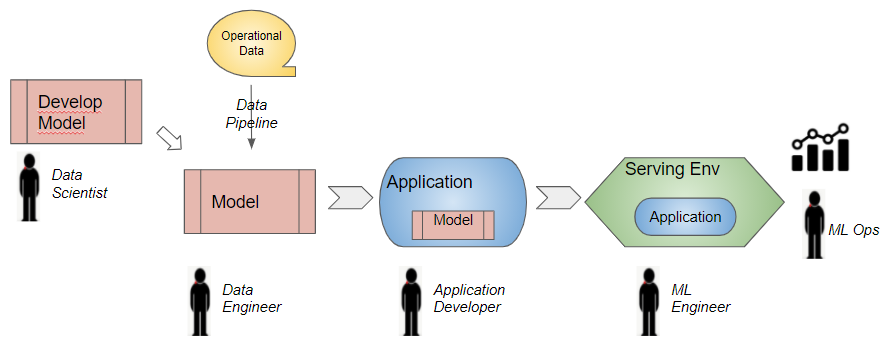
A Gentle Guide to the complexities of model deployment, and integrating with the enterprise application and data pipeline. What the Data Scientist, Data Engineer, ML Engineer, and ML Ops do, in Plain English.

Ketan Doshi

Jun 28  ·  11 min read


Let’s say we’ve identified a high-impact business problem at our company, built an ML (machine learning) model to tackle it, trained it, and are happy with the prediction results. This was a hard problem to crack that required much research and experimentation. So we’re excited about finally being able to use the model to solve our user’s problem!

However, what we’ll soon discover is that building the model itself is only the tip of the iceberg. The bulk of the hard work to actually put this model into production is still ahead of us. I’ve found that this second stage could take even up to 90% of the time and effort for the project.
So what does this stage comprise of? And why is it that it takes so much time? That is the focus of this article.

Over several articles, my goal is to explore various facets of an organization’s ML journey as it goes all the way from deploying its first ML model to setting up an agile development and deployment process for rapid experimentation and delivery of ML projects. If you’re interested, here’s my other article on this topic:

In order to understand what needs to be done in the second stage, let’s first see what gets delivered at the end of the first stage.

What does the Model Building and Training phase deliver?

Models are typically built and trained by the Data Science team. When it is ready, we have model code in Jupyter notebooks along with trained weights.

  • It is often trained using a static snapshot of the dataset, perhaps in a CSV or Excel file.
  • The snapshot was probably a subset of the full dataset.
  • Training is run on a developer’s local laptop, or perhaps on a VM in the cloud
In other words, the development of the model is fairly standalone and isolated from the company’s application and data pipelines.

Real-time Inference and Retraining in Production (Image by Author)


What does “Production” mean?

When a model is put into production, it operates in two modes:
  • Real-time Inference — perform online predictions on new input data, on a single sample at a time
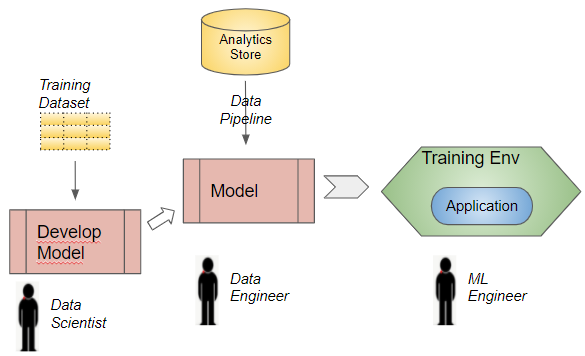
  • Retraining — for offline retraining of the model nightly or weekly, with a current refreshed dataset
The requirements and tasks involved for these two modes are quite different. This means that the model gets put into two production environments:
  • A Serving environment for performing Inference and serving predictions
  • A Training environment for retraining


Real-time Inference is what most people would have in mind when they think of “production”. But there are also many use cases that do Batch Inference instead of Real-time.

  • Batch Inference — perform offline predictions nightly or weekly, on a full dataset
Batch Inference and Retraining in Production (Image by Author)


For each of these modes separately, the model now needs to be integrated with the company’s production systems — business application, data pipeline, and deployment infrastructure. Let’s unpack each of these areas to see what they entail.

We’ll start by focusing on Real-time Inference, and after that, we’ll examine the Batch cases (Retraining and Batch Inference). Some of the complexities that come up are unique to ML, but many are standard software engineering challenges.

Inference — Application Integration

A model usually is not an independent entity. It is part of a business application for end users eg. a recommender model for an e-commerce site. The model needs to be integrated with the interaction flow and business logic of the application.

The application might get its input from the end-user via a UI and pass it to the model. Alternately, it might get its input from an API endpoint, or from a streaming data system. For instance, a fraud detection algorithm that approves credit card transactions might process transaction input from a Kafka topic.

Similarly, the output of the model gets consumed by the application. It might be presented back to the user in the UI, or the application might use the model’s predictions to make some decisions as part of its business logic.

Inter-process communication between the model and the application needs to be built. For example, we might deploy the model as its own service accessed via an API call. Alternately, if the application is also written in the same programming language (eg. Python), it could just make a local function call to the model code.

This work is usually done by the Application Developer working closely with the Data Scientist. As with any integration between modules in a software development project, this requires collaboration to ensure that assumptions about the formats and semantics of the data flowing back and forth are consistent on both sides. We all know the kinds of issues that can crop up. eg. If the model expects a numeric ‘quantity’ field to be non-negative, will the application do the validation before passing it to the model? Or is the model expected to perform that check? In what format is the application passing dates and does the model expect the same format?

Real-time Inference Lifecycle (Image by Author)


Inference — Data Integration

The model can no longer rely on a static dataset that contains all the features it needs to make its predictions. It needs to fetch ‘live’ data from the organization’s data stores.

These features might reside in transactional data sources (eg. a SQL or NoSQL database), or they might be in semi-structured or unstructured datasets like log files or text documents. Perhaps some features are fetched by calling an API, either an internal microservice or application (eg. SAP) or an external third-party endpoint.

If any of this data isn’t in the right place or in the right format, some ETL (Extract, Transform, Load) jobs may have to be built to pre-fetch the data to the store that the application will use.

Dealing with all the data integration issues can be a major undertaking. For instance:

  • Access requirements — how do you connect to each data source, and what are its security and access control policies?
  • Handle errors — what if the request times out, or the system is down?
  • Match latencies — how long does a query to the data source take, versus how quickly do we need to respond to the user?
  • Sensitive data — Is there personally identifiable information that has to be masked or anonymized.
  • Decryption — does data need to decrypted before the model can use it?
  • Internationalization — can the model handle the necessary character encodings and number/date formats?
  • and many more…
This tooling gets built by a Data Engineer. For this phase as well, they would interact with the Data Scientist to ensure that the assumptions are consistent and the integration goes smoothly. eg. Is the data cleaning and pre-processing done by the model enough, or do any more transformations have to be built?

Inference — Deployment


It is now time to deploy the model to the production environment. All the factors that one considers with any software deployment come up:

  • Model Hosting — on a mobile app? In an on-premise data center or on the cloud? On an embedded device?
  • Model Packaging — what dependent software and ML libraries does it need? These are typically different from your regular application libraries.
  • Co-location — will the model be co-located with the application? Or as an external service?
  • Model Configuration settings — how will they be maintained and updated?
  • System resources required — CPU, RAM, disk, and most importantly GPU, since that may need specialized hardware.
  • Non-functional requirements — volume and throughput of request traffic? What is the expected response time and latency?
  • Auto-Scaling — what kind of infrastructure is required to support it?
  • Containerization — does it need to be packaged into a Docker container? How will container orchestration and resource scheduling be done?
  • Security requirements — credentials to be stored, private keys to be managed in order to access data?
  • Cloud Services — if deploying to the cloud, is integration with any cloud services required eg. (Amazon Web Services) AWS S3? What about AWS access control privileges?
  • Automated deployment tooling — to provision, deploy and configure the infrastructure and install the software.
  • CI/CD — automated unit or integration tests to integrate with the organization’s CI/CD pipeline.
The ML Engineer is responsible for implementing this phase and deploying the application into production. Finally, you’re able to put the application in front of the customer, which is a significant milestone!
However, it is not yet time to sit back and relax 😃. Now begins the ML Ops task of monitoring the application to make sure that it continues to perform optimally in production.

Inference — Monitoring


The goal of monitoring is to check that your model continues to make correct predictions in production, with live customer data, as it did during development. It is quite possible that your metrics will not be as good.

In addition, you need to monitor all the standard DevOps application metrics just like you would for any application — latency, response time, throughput as well as system metrics like CPU utilization, RAM, etc. You would run the normal health checks to ensure uptime and stability of the application.

Equally importantly, monitoring needs to be an ongoing process, because there is every chance that your model’s evaluation metrics will deteriorate with time. Compare your evaluation metrics to past metrics to check that there is no deviation from historical trends.

This can happen because of data drift.

Inference — Data Validation


As time goes on, your data will evolve and change — new data sources may get added, new feature values will get collected, new customers will input data with different values than before. This means that the distribution of your data could change.

So validating your model with current data needs to be an ongoing activity. It is not enough to look only at evaluation metrics for the global dataset. You should evaluate metrics for different slices and segments of your data as well. It is very likely that as your business evolves and as customer demographics, preferences, and behavior change, your data segments will also change.

The data assumptions that were made when the model was first built may no longer hold true. To account for this, your model needs to evolve as well. The data cleaning and pre-processing that the model does might also need to be updated.

And that brings us to the second production mode — that of Batch Retraining on a regular basis so that the model continues to learn from fresh data. Let’s look at the tasks required to set up Batch Retraining in production, starting with the development model.


Retraining Lifecycle (Image by Author)


Retraining — Data Integration


When we discussed Data Integration for Inference, it involved fetching a single sample of the latest ‘live’ data. On the other hand, during Retraining, we need to fetch a full dataset of historical data. Also, this Retraining happens in batch mode, say every night or every week.

Historical doesn’t necessarily mean “old and outdated” data — it could include all of the data gathered until yesterday, for instance.

This dataset would typically reside in an organization’s analytics stores, such as a data warehouse or data lake. If some data isn’t present there, you might need to build additional ETL jobs to transfer that data into the warehouse in the required format.


Retraining — Application Integration


Since we’re only retraining the model by itself, the whole application is not involved. So no Application Integration work is needed.


Retraining — Deployment


Retraining is likely to happen with a massive amount of data, probably far larger than what was used during development.

You will need to figure out the hardware infrastructure needed to train the model — what are its GPU and RAM requirements? Since training needs to complete in a reasonable amount of time, it will need to be distributed across many nodes in a cluster, so that training happens in parallel. Each node will need to be provisioned and managed by a Resource Scheduler so that hardware resources can be efficiently allocated to each training process.

The setup will also need to ensure that these large data volumes can be efficiently transferred to all the nodes on which the training is being executed.

And before we wrap up, let’s look at our third production use case — the Batch Inference scenario.

Batch Inference


Often, the Inference does not have to run ‘live’ in real-time for a single data item at a time. There are many use cases for which it can be run as a batch job, where the output results for a large set of data samples are pre-computed and cached.

The pre-computed results can then be used in different ways depending on the use case. eg.

  • They could be stored in the data warehouse for reporting or for interactive analysis by business analysts.
  • They could be cached and displayed by the application to the user when they log in next.
  • Or they could be cached and used as input features by another downstream application.
For instance, a model that predicts the likelihood of customer churn (ie. they stop buying from you) can be run every week or every night. The results could then be used to run a special promotion for all customers who are classified as high risks. Or they could be presented with an offer when they next visit the site.

A Batch Inference model might be deployed as part of a workflow with a network of applications. Each application is executed after its dependencies have completed.

Many of the same application and data integration issues that come up with Real-time Inference also apply here. On the other hand, Batch Inference does not have the same response-time and latency demands. But, it does have high throughput requirements as it deals with enormous data volumes.

Conclusion


As we have just seen, there are many challenges and a significant amount of work to put a model in production. Even after the Data Scientists ready a trained model, there are many roles in an organization that all come together to eventually bring it to your customers and to keep it humming month after month. Only then does the organization truly get the benefit of harnessing machine learning.

We’ve now seen the complexity of building and training a real-world model, and then putting it into production. In the next article, we’ll take a look at how the leading-edge tech companies have addressed these problems to churn out ML applications rapidly and smoothly.

What Every Small Business Needs to Know About Data-Driven Marketing

(Source: business2community.com

Jill Davis | June 16, 2021

As a small business owner, you’re the CEO, Chief Marketing Officer, Chief Financial Officer, Customer Service Rep, everything all at once. You have multiple balls in the air and are switching roles at any given time. You always have one eye on growing your online sales, but you might find it tough to stay on top of best practices in marketing due to competing priorities.

The truth is, marketing has changed a lot in recent years. With more people making online purchases (and boatloads of customer data being collected), marketing has become very data-driven. More and more of our customers who sell online (and have more than 2,500 email subscribers) are moving to our Ecommerce Pro plan because it supports this relatively new way of marketing.

Data-driven marketing might sound a little intimidating and time-consuming, but with the right approach, it’s actually totally accessible, even for novice marketers. Below, I’ll explain what data-driven marketing is, and how it can make your life easier and your small business more successful.


What is data-driven marketing?

Ok, I’ll admit, the term “data-driven marketing” sounds vague and complicated but it really boils down to using customer data to better engage with your customers and improve the effectiveness of your marketing.

Think about all the data that is collected when you shop online:

  • Which email brought you to the site to make the purchase?

  • At what time of day did you read and take action on the email?

  • What did you purchase?

  • Are you a first-time or repeat customer?

  • Did you take advantage of a sale or pay full price?

  • What other products did you browse?

This is just the tip of the iceberg in terms of the many types of customer data that are collected and stored.

The highest-performing marketing platforms can use all this data and knowledge to connect with your customers and keep them interested in the brand. Think about it — which types of email messages are you happy to receive? They are likely ones that provide you with interesting, helpful, or entertaining content, tailored to your preferences.

Those great email messages are no accident. They’re possible due to data-driven marketing. A sneaker brand might know that you typically purchase twice a year, and opt for bright colors. Wouldn’t it make sense, then, to skip the weekly promo blast emails (that could annoy you and drive you to unsubscribe) and send fewer messages, featuring sneakers in bright colors?


Data-driven marketing is easier than it sounds

Do you think you need to be an analytical wiz to get started with data-driven marketing? You don’t, because technology allows you to collect, organize and make sense of all of your data. For example, small business owners who opt for our Ecommerce Pro plan benefit from the built-in customer data platform (or CDP).

This CDP pulls in the data from your various marketing tools and ecommerce platforms (e.g. Shopify, Magento, BigCommerce) and gives you a clear picture of every customer, and when and how you should market to them. You can learn so much about your customers and their buying habits and interests, and that knowledge allows you to be much better at marketing to them.

Could you dig in further and learn more about data-driven marketing if you wanted to? Of course you could. Our team of ecommerce experts and data scientists (the ones who built the technology powering the Ecommerce Pro plan) could explain why your customers are being segmented the way they are, and why certain products are being recommended to certain customers.

They could explain things like the smart subject lines feature, a nifty little tool that uses data from the millions of emails we send every month to show you which ones are predicted to perform better (indicated with a green up arrow) or worse (indicated with a red down arrow). Why is this so useful? Subject line effectiveness is closely linked with email open rates, which are linked to revenue.

Smart Subject Lines helps you make a data-informed decision on the best subject line to use to maximize your email open rate.

New Ecommerce Pro plan customers also find the ecommerce playbooks helpful, because they are a preconfigured, “out of the box” feature that gets you up and running immediately with data-driven marketing. The playbooks use your customer data to ensure your emails get to the right prospects or customers no matter where they are in their buying journey.


Data-driven marketing is the key to keeping your customers

I alluded to this earlier, but one of the biggest reasons for writing this article is to underscore how important data-driven marketing is for keeping your customers. If you use your customer data to deliver personalized messages to your customers, they will be more likely to engage with your brand, make repeat purchases, and remain loyal.

So do you need a degree in data science to be successful with data-driven marketing? Absolutely not. You just need to continue doing what you’ve always done, keeping your eye on the ball and adapting in order to stay competitive.

Four Things AI Can Do Today to Help Your Company Thrive

(Source: aithority.com)

By William Li 
Jun 13, 2021

Not long ago, artificial intelligence (AI) seemed like part of some distant, cyborgian future. Now, everywhere you turn, AI is shaping the way we live.

From algorithms that design our social media feeds to voice-activated technology ready to answer the most mundane of questions (“Hey Siri, what’s the forecast for today?”), AI has crossed over from otherworldly to the here and now. But what about for businesses?

AI can be a huge boon for marketers who have spent decades in the dark, wondering what tactics work and what doesn’t when it comes to their marketing and customer service practices.

As someone who has spent 15years analyzing and improving AI-driven outcomes for businesses, I’ve come up with four tips that companies can use right now to boost their customer loyalty and sales. From my research based on conversation intelligence data, AI has the power to:


Capture Lost Leads in Real-time

According to 2020 data analyzed from hundreds of thousands of phone conversations between customers and auto dealers across the US, dealers only have mere seconds to reconnect with a customer who hangs up because of long hold times.

There are two parts to this truth. Number one: long hold times are bad. Very bad. Customers get frustrated, give up and move on to the next retailer. The second truth? Not all lost connections are lost forever. Once a customer hangs up or a call drops, dealers can still convert that customer – if they’re-engage on the opportunity quickly. But wait five minutes and the window closes. We know this because of, and only because of, AI.

AI’s ability to process real-time data and prioritize lost leads at lightning-fast speeds is unsurpassed. Here’s how it works: AI instantly analyzes billions of bits of conversation data, identifies a lost lead and alerts the seller to call back to take immediate action. AI can also identify missed opportunities during a conversation.

For instance, say a potential customer calls a home services business about her hot water tank that’s having a problem.

The salesperson does all the right things, BUT he forgets to ask how old the water tank is. In this scenario, AI steps in, prodding the salesperson with an alert on his screen, “How old is the water tank?” If a water tank is more than ten years old, it should be replaced— not just repaired. That scenario ends in a higher-margin sale and a more satisfied customer down the road.


Close the Gap Between Sales and Marketing with Combined Signals for More Accurate Lead Prediction

Today, CRM systems largely fail at linking tiny bits of customer data and marketing campaigns together. When businesses rely solely on CRM software, the end-to-end customer experience suffers.

This is where AI comes in. It can track links that customers click on, as well as other customer behaviors, such as texts a customer sent and whether he or she tried to reach a business by phone. All this data is aggregated and examined at a rapid-fire rate to help businesses understand and predict, in real time, which sales and marketing campaigns are working and which aren’t.

When you can quantitatively connect how ad campaigns drive customer actions and how customer service actions drive sales, the experience for the customer improves across all online and offline touchpoints.


Enrich Customer Experience through Multichannel Engagement

Here’s what customers want today: a seamless, end-to-end buying experience. Multichannel cohesion across voice, text and desktop is imperative. And AI can facilitate this brilliantly.

Let’s say you’re looking at hotels online and a chatbot appears in the corner.

You ask the bot, is there any availability in the summer? Do you have an ocean-facing, two-room suite? The bot responds that an ocean-facing option isn’t available at the moment but promises to send a text or to have a customer service rep call when something opens up.

The chat bot, though sometimes awkward to interact with, can assemble crucial pieces of understanding tied to what customers want. The bot can then ask for a customer’s number or email to follow up and the bot can do this at scale. AI can then digest what customer preferences are in one channel and bring that knowledge into the next step.


Increase Seller Productivity through AI Assistants


This is a scenario that happens often in the world of sales. The seller reaches out to a customer by phone, but the customer is busy and can’t talk at the moment. Now, sellers no longer have to see callbacks as an hours-long, exhausting endeavor. That’s because AI can reach out to hundreds of people in a single day.

In the course of each of these conversations, AI can ask some simple questions that help the seller focus more on those interactions that are more likely to lead to sales. I call it “Using the AI as an assistant at scale.”This prioritizes follow up action for higher conversions. And it’s done through the power of AI recommendations.

AI has moved from hype to hyper-real. Every day it’s becoming more indispensable toward improving sales effectiveness and providing workflow assistance. Using AI is a crucial leap forward in boosting sales team performance as well as a company’s bottom line.

The most recent dish... enjoy!

How the IRS is trying to nail crypto tax dodgers

(Source: cnbc.com )  PUBLISHED WED, JUL 14 2021, 12:08 PM EDT; UPDATED THU, JUL 15 2021 2:00 PM EDT MacKenzie Sigalos  @KENZIESIGALOS KEY PO...

Popular Dishes